
⛹️♀️ Box Clever
It's hard to explain what transport planners do and why it is important. But the Transport Box gives a chance to do that, and you can have that opportunity too

Good day my good friend.
I just thank you to everyone who reached out after my recent newsletter on my experience of a road traffic collision. That does mean a lot to me, thank you. But I can assure you that I am ok. As I mentioned in the newsletter, this is not my first road traffic collision. Anyway, onto something more joyful.
There is a particular kind of question that only a child can ask. You know what I mean. The questions that are devastatingly simple. They are direct, curious, and have no patience for professional terms. It does not care whether your answer fits neatly into a job title, or an important email.
I was reminded of this at a Transport Box session in Birkenhead, where I spent time with a group of kids and their parents talking about transport. The Transport Box is designed to bring engineers, transport professionals, young people, families and community partners together through creative, practical activities about how transport works in everyday life.
I was asked loads of questions.
About trains. There were a lot of questions about trains, including questions about expansions to Merseyrail I had never even heard of.
About signals. That was more Joanna’s bag, but I think I held my own. Though if I was posed a question about the software used to determine signal timings I would have been in trouble.
About how things work. How exactly do you tell a child about how you choose one route or another, and not bore them with an explanation about Transport Appraisal Guidance?
About what I actually do every day. This one is the hardest one to answer.
It is easy enough to explain a signal in simple terms. It is possible to describe a train line, a junction, a crossing, or a bus route. But explaining what you do, and why it matters, is different. It forces you to strip away the language we sometimes hide behind. It asks you to find the humanity in it all that people can relate to.
And the humanity is the point.
Transport can become abstract very quickly. We talk about networks, flows, demand, capacity, mode shift, interventions and outcomes. All of that matters. But it only matters because people are trying to get somewhere. I often think we forget that transport is a derived demand. People are trying to get to school, work, home, to see family and friends, go to a medical appointment, or see a football match, or much more besides. A place where they feel like themselves.
The Transport Box, created by UK Unplugged working alongside volunteers from Mobility Camp, works because it starts there. It makes transport visible and practical in human terms. Its activities include a race across a city, creating a model of a skateboard, bus stop bingo, and much more. In Birkenhead, we played a swept path game created by Mai-Leen, and Joanna’s signals game. All simple things that help children understand engineering and transport planning ideas in accessible ways.
It is not trying to deliver a dry technical lesson. It is trying to create something playful, welcoming and accessible, where young people can notice how streets work, ask questions, think about different needs, and imagine how transport could be safer, fairer and easier to use.
That is more powerful than it sounds.
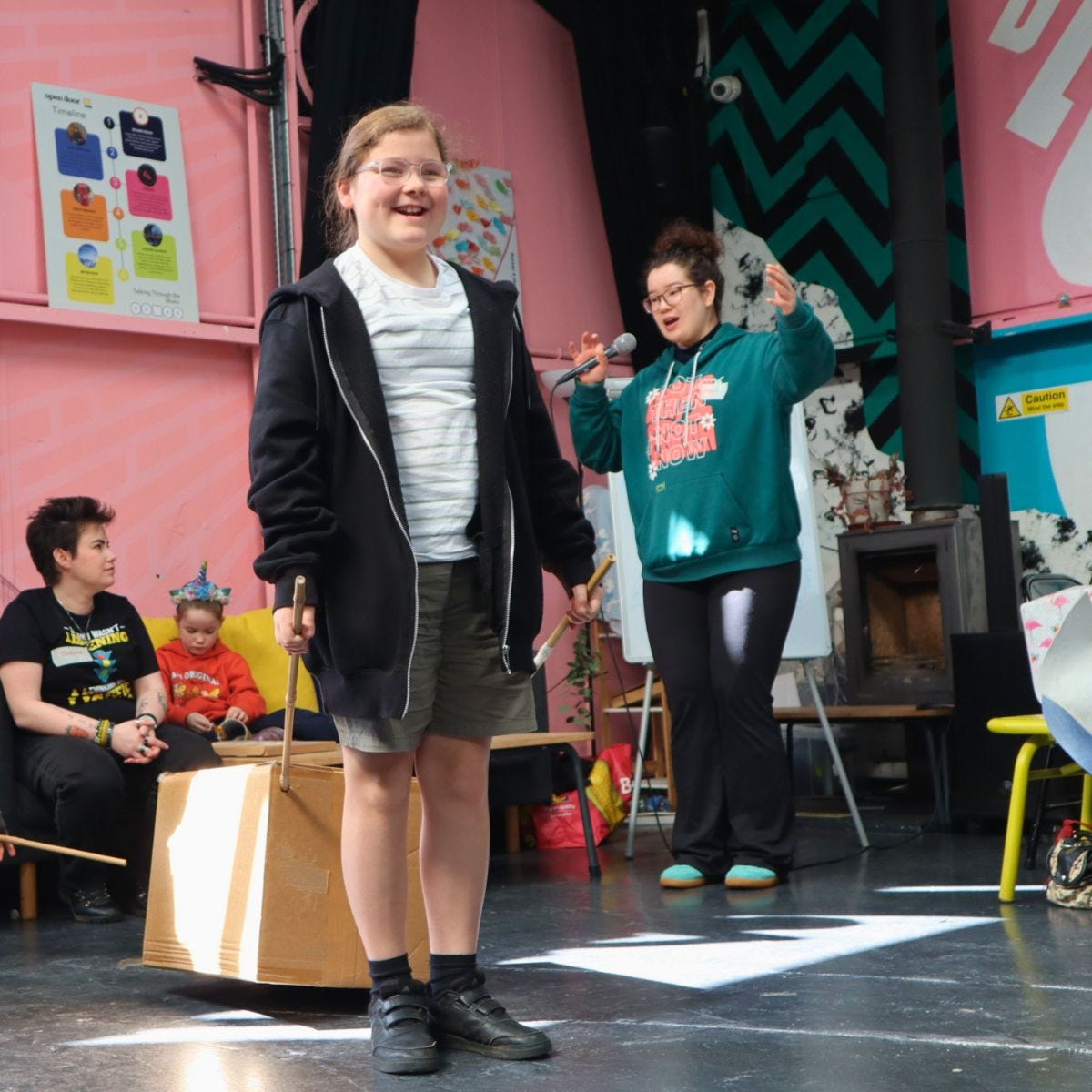
Because once you start answering questions from children, you realise how much of our work depends on trust. Why is a crossing there and not somewhere else? Why do signals take so long? Why can some people travel easily while others cannot? Why do roads feel dangerous? Why do buses not always go where people need them to go?
All of these asked by children. But these questions are far from childish. They are the questions at the centre of transport planning.
The session in Birkenhead was hugely inspiring in its own way. Not because everyone left wanting to become an engineer or a transport planner, although some might. Not because I had all the answers, because I definitely did not. It was inspiring because it reminded me that our work matters, and people can see how it matters. We can share what we do in open and accessible ways.
I have sat in numerous Transport Planning Society meetings where the matter of engaging with young people and getting them interested in transport planning comes up. But then we talk about it like its moving numbers on a spreadsheet and doing stuff behind a computer screen. This is important, but we have to be clear to young people that this is about achieving an end goal. We do this because we are planning to make every day journey’s better.
I might be running numbers to develop a business case for a scheme. But ultimately, this is about things like creating a new railway line to link two places together, or to provide somewhere that people can ride their bikes safely. And when you talk about it like that, something shifts.
Explaining why what I do is important is an amazing feeling. It is easy to forget that when the day job is full of meetings, emails, spreadsheets and deadlines. But in that room, answering the questions of excited 8 year olds, the connection was obvious. Transport is not just infrastructure. It is independence. It is access. It is safety. It is confidence. It is whether people feel that the places around them have been designed with them in mind.
That is why projects like the Transport Box matter.
They give young people a way into transport planning and engineering without making it feel remote. They also give professionals a way back to first principles, and to tell the world why what we are doing matters.
The Transport Box project is now looking for engineers and transport professionals to get involved, with training, co-design activities and in person events that make transport engineering more visible, accessible and relevant to young people and their families. We will be running sessions and versions of the Box in Stockport and Leeds, and if you want to be part of it then sign up by 30th May. You can find out more details on this on the Mobility Camp website.
If you work in transport, highways, rail, signals, planning, safety, public transport, walking, cycling, accessibility, systems or anything nearby, I would really encourage you to take part.
Not because outreach is a nice extra. Not because of the CPD (though you will get the equivalent of 7 hours for it). But because exciting the next generation is an amazing feeling, and we need them to carry on our task of creating a better world.
We need people who can design better systems. We also need people who can explain them, question them, and invite others into the conversation. The Transport Box does that in a way that feels generous, grounded and genuinely useful. And if even one young person who we engage with goes on to become an engineer, its worth it.
So sign up. Bring what you know. Be ready for brilliant questions. And be ready to remember why what we do matters.
👩🎓 Latest Research
The clever clogs at our universities, government departments, and other clever people have published the following excellent research. Where you are unable to access the research, email the author – they may give you a copy of the research paper for free.
TL:DR - This paper is explicitly about Active Mobility To and from School (AMTS) and focuses on children and adolescents aged 8–16 years in Bogotá, Maputo and Marracuene. It treats school travel as a transport-planning and public-health issue and develops a four-step implementation framework for walking- and cycling-to-school interventions in low- and middle-income settings.
TL:DR - This study looks at children and adolescents aged 10–17 and develops a validated tool for measuring the motivation behind cycling to and from school. It found that a three-factor model of motivation worked well, and that both autonomous motivation and controlled motivation were associated with a greater likelihood of cycling to school, while amotivation reduced it.
TL:DR - Using three-wave longitudinal data from 1,235 urban adolescents in Shanghai, the study found that facilities/environment, teacher competence, and curriculum design all positively predicted later physical activity habit formation. The strongest longer-term influence came from curriculum guarantees, while peer effects appeared later rather than immediately.
TL:DR - This mixed-methods study used parent–adolescent dyads (N = 517) plus qualitative interviews to examine barriers and predictors of active school commuting. It found that adolescents and parents both saw luggage, weather, traffic safety, convenience, lack of social support, and “getting a lift” as important barriers.
TL:DR - This longitudinal study of Brazilian high-school students found that public transport use was associated with roughly a threefold increase in the odds of worsening depression, and that this rose even further for students living 5 km or more from school.
💁♂️ Help Available
Over the last few months I have been working with a great guy called Kevin, who is interested in getting into transport planning. He has been helping me out with some odd projects, and I can safely say that he is a hard worker and very eager to learn. However, I am in a position where my work for him is starting to dry up, and he has come so far that I don’t want him to lose momentum.
So, I am reaching out to you, dear reader. If you are someone who is willing to take on an intern or volunteer to shadow you in your transport work, and you have the patience to make it work and are based in the UK, please let me know by emailing in response to this newsletter.
💻 Hard Work
The work part of last week was boring. Mainly meetings. However, last weekend was not work, but it was great fun as I spent a few days in Germany.
Many of these days were spent with my sister and three of my nephews in Weinheim in Baden-Württemberg. I also spent some time in Frankfurt which I will write about next week, but Weinheim is just stunning. Being sat in the sun in the Marktplatz, outside a cafe eating Schnitzel, listening to your nephew who wants to become a Städteplaner = perfect.


Oh, and I got to finally pay a visit to Frankfurt (Main) Hauptbahnhof, a station that Deutsche Bahn refers to as the most important station in Germany. I must admit that this is probably the first station I have been to that I did not feel safe at. Mainly because there were a lot of blackshirts around for reasons I did not ask about (if you don’t know what blackshirts are, don’t Google it). It was also extremely busy with a relatively confined area for passenger movement that reminded me a lot of the layout of Liverpool Street Station. However, the architecture of the station is amazing.
🎶 Musical Finale
I love Daughter by Pearl Jam as its a banging tune. Its only in recent years that I finally understood that the lyrics describe the experience of children with learning disabilities. As Pearl Jam singer Eddie Vedder said:
The child in that song obviously has a learning difficulty, and it’s only in the last few years that they’ve actually been able to diagnose these learning disabilities, that before were looked at as misbehavior; as just outright rebelliousness, but no one knew what it was. These kids, because they seemed unable or reluctant to learn, they’d end up getting the s—t beaten outta them. The song ends, you know, with this idea of the shades going down—so that the neighbors can’t see what happens next. What hurts about s—t like that is that it ends up defining people’s lives. They have to live with that abuse for the rest of their lives. Good, creative people are just f——-g destroyed.
This turns it from a great song into something much more profound.