
🤦♂️ Motonormativity in a Nutshell
Yesterday I was involved in something nobody wants to be, and it frustrated me no end

Good day my good friend.
A forewarning ahead of this week’s post. My tone can only be described as that of righteous fury, and so it gets a bit ranty and goes off in tangents. If you don’t like that kind of thing, or you don’t like reading about road traffic collisions, its best to give this week’s a miss.
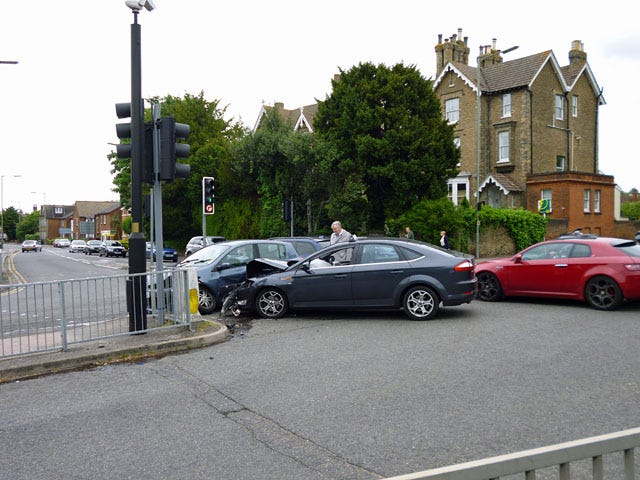
On Thursday morning, on Cambridge Road near Orwell in Cambridgeshire, I found myself standing in the middle of a scene that I cannot stop replaying in my mind. I arrived probably a minute after it happened. I did not see the collision itself. I cannot tell you how it happened, who was at fault, or what the seconds before impact looked like. What I can tell you is what I arrived to. A motorcyclist was lying injured in the road, his motorcycle smashed to bits some way behind him. He was screaming in pain. The sound of it cut through everything - the hum of engines, the confusion, the rush of people trying to understand what had happened. The plans for the day of several people wrecked by all-too-familiar horror.
This is not my first time on the scene of a road traffic collision. Nor will it likely be my last. The downside of being a transport planner or engineer is that at some point you will be on the scene of a road traffic collision. I have been on the scene of several. Some were fatal collisions caused by the idiocy of the person who somehow walked away. Others had the people in the vehicles involved joking at the roadside, shaken but otherwise unharmed. After a while, you almost get numb to it. An automatic response kicks in - whether it be to help the injured, dial 999 or something else.
In those moments, there are things you expect to see from people. Shock, certainly. Concern, hopefully. Hesitation, perhaps. Sadly, there is something else I have come to expect. Something that always leaves me angry. That was the number of drivers who looked at a badly injured man lying in the carriageway and still tried to drive through the scene. Not around it, through it. Literally passing within inches of him and those trying to help.
I would normally say it seems unreal, or that it’s too ugly to true. But it isn’t. This is not the first time I have seen this at the scene of a serious collision, either.
There were people there who did exactly what you would hope strangers would do. Some stopped immediately, and tried to comfort the injured rider. Others were visibly shaken themselves but still stayed. A handful of people became the sort of people a situation like this needs. They put decency ahead of inconvenience. I want to say that clearly because it matters. It matters that kindness was present in that horrible scene. It matters that some people, with no obligation beyond their own humanity, stopped and helped.
But it also matters that others did the opposite.
My role, in the end, became traffic management. None of us wake up expecting to stand on a road trying to keep other road users from driving over or near an injured person. Yet that was where things ended up. I found myself directing vehicles, signalling for drivers to turn around, trying to create the most basic level of safety around an already unsafe and chaotic scene. All while those with some medical training helped before the emergency services arrived. And the awful truth is that the only way I could finally stop some drivers from trying to push through was by working with others to physically block the road. Starting with myself and another woman, then with cars near the scene, then using a lorry and the kind actions of an unknown lorry driver, and finally some kind hearted highways engineers who happened to be passing by who put out their own Road Closed sign. All before the police finally came to do the job properly.
Think about what that means for a moment. An injured man was lying in the road, in clear distress, with people around him trying to help. And still the message some drivers seemed to take from the situation was “can I still get through?” Even when blocked some tried to take chances. Some got angry at us for not allowing them through. Angry. As if the real offence in that moment was not the suffering in front of them but the interruption to their journey.
I have spent a lot of today thinking about that anger. What makes someone see a road traffic collision, see an injured human being, and respond with irritation at being delayed. What sort of mental framing puts convenience above care so quickly, so instinctively, that the suffering of another person seems not to matter. I keep coming back to the same answer. This is motonormativity in action.
Motonormativity is the name given to the way our culture treats motor vehicle use, and the harms, risks, and expectations wrapped up in it, as normal, acceptable, and often beyond question. It describes the strange moral leniency we extend to driving and to the inconvenience driving imposes on others. It is the reason why many forms of danger, noise, delay, intimidation, and even death are absorbed into public life as regrettable but ordinary. They are simply the price worth paying. It is the reason roads are so often treated first and foremost as channels for vehicle flow, rather than as public spaces where human vulnerability matters.
When motonormativity takes hold, the presence of a car shapes how people think. It creates a worldview in which stopping is an affront, where delay feels like injustice, and where anything that interrupts the smooth onward passage of traffic is treated as the problem. An injured man in the road becomes not the centre of concern but an obstacle. The person trying to protect the scene becomes not someone acting out of basic responsibility but someone who is in the way.
In a weird way, this is why I don’t think those who drove through the scene are fundamentally bad or evil people. The conditioning of society makes them do bad things but it also makes them feel that doing what they did is right, or at least justified.
That is what is so enraging. You can make the case that this is at least selfishness, but its not one that is a judgment on a person’s character in the traditional sense. It is a deeper and more embedded selfishness, one dressed up as normal behaviour because our roads teach it every day. Drivers are encouraged, in subtle and obvious ways, to see the road as theirs to move through. If a road closes, people ask how they can get around it. If someone is hit, injured, or endangered, the question too often becomes how long will this take and can I get through, with not how that person is being a secondary question.
That moral inversion is not accidental. It is built into the way we design roads, talk about traffic, and assess inconvenience. We speak about keeping traffic moving as though it is a public good above almost all others. Congestion is framed as a social ill. Against that backdrop, empathy is a fragile thing.
I do not want to exaggerate what I saw, but neither do I want to soften it. There were drivers who were prepared to continue inching through a collision scene while a badly injured person lay in front of them. There were people who, even when confronted by someone trying to stop them for reasons that should have been blindingly obvious, still acted as if the unwritten rules of the priority of traffic ought to prevail.
This is what motonormativity does. An obvious cruel act is easy to point at and judge. More often it produces a deadening of moral attention. It trains people to keep looking ahead to their own destination, their own schedule, their own lane position, their own right of way. It does not necessarily make people evil. It makes them casual in the presence of risk to others, and impatient around vulnerability.
It is such vulnerability that, in the scene of a collision, is hard to ignore. It’s not an abstract risk. It’s a man screaming in pain in the road. That is the thing the insulated logic of car culture tries to hide. Behind a windscreen, with the engine running and the route in mind, it is all too easy to experience the world as a set of moving and stationary impediments. The car cocoons us. controlling temperature, sound, speed, music, comfort, direction. It can turn public space into private bubble. But outside that bubble are people whose vulnerability does not vanish because your trip to you.

What I felt this morning was anger, yes, but underneath it was something like grief for the quality of public life that we lose when this way of thinking becomes normal. Road traffic collisions show if our moral core is able to overcome motonormativity. Faced with sudden harm, who are we? Do we slow down and help? Do we step back and give space? Do we act with care? Or do we press on, privately resent the disruption?
The answer, today, was mixed. That is partly why it has stayed with me.
I saw people who were clearly in shock. That is completely understandable, as these events are frightening and disorienting. Not everyone knows what to do, nor are they equipped to take practical action. I do not judge that. We are human, and emergencies are hard. But there is a world of difference between being overwhelmed by what you have witnessed and being annoyed that somebody else’s trauma is slowing your commute. One is a human reaction to something awful. The other speaks to whether your moral core can see past the world shown to you by your windscreen.
The people who stopped to help deserve more than a passing mention. They were strangers. Most did not know the injured rider, as far as I could tell. They had no special duty to him beyond the duty we all owe one another as fellow human beings. Yet they stopped. They cared. They stayed - after all, half of the effort of being there for someone is physically being there. There was no audience. No applause, nor reward. Just people recognising suffering and refusing to walk away from it.
That matters. It matters more than I can say, because if all I had seen this morning was indifference and aggression, I think I would feel worse than angry. I would feel despair, but I don’t. Anger? Certainly, and disgust at the conduct of some drivers. But I also feel that decency is still there. It may not always be the most obvious thing. But if you look, it is there.
The reason I keep returning to motonormativity is precisely because I do not think this was simply about a handful of unusually selfish people. I think it revealed something more widespread and more ordinary. Too many people are accustomed to seeing delays as personal affronts. They have learned, through habit and infrastructure and culture, to put the needs of traffic above the needs of people.
If we are serious about tackling that, we need more than pleas for individual kindness - we need a cultural shift. We need to rehumanise what roads are for and who they are for. Roads run through communities. They connect homes, schools, shops, villages, workplaces, and lives. They are not just conduits for moving vehicles. They are shared spaces where the first principles should be safety, caring, and fostering a sense of community.
That means changing how we talk. It means refusing to treat injury and death on the roads as an inevitability to manage. This means questioning assumptions that put vehicle speed and convenience first. It also means recognising that impatience behind the wheel is not a harmless personality trait when it shapes behaviour around vulnerable people.
It also means changing how we respond in the moment. If you come upon a crash scene, your first instinct should be to slow down, stop if safe and appropriate, follow directions, and understand that your inconvenience is trivial compared with somebody else’s injury. That should be obvious. Yet clearly, for too many people, it is not. We need to say it anyway. We need to say that trying to squeeze through a live collision scene is dangerous and stupid. That doing this is a moral failing, even if you are not a bad person.
I keep thinking about how closely the drivers in those vehicles came to making the whole thing worse. Inches. Literal inches between a person already grievously hurt and vehicles still trying to pass. Inches between help and further harm. It should never have come to that. The fact that it did should trouble all of us, especially those who care about road safety, transport policy, and the broader culture that surrounds car use.
And yet, for all that anger, I do not want to end on a bad note because that would not be true to what I witnessed either. I also saw courage, compassion, and calm. There were strangers who did not know each other and certainly did not plan to spend their morning together, but who became a temporary community because somebody was hurt and needed help. In the middle of noise and confusion, they chose to do the right thing.
That choice matters because it reminds us that motonormativity is powerful, but it is not total. People can resist it. They can step out of the logic of urgency and entitlement. They can remember, all at once, that a road is not simply a route but a place where human beings can suffer and where other human beings can decide to care. They can refuse the thought that says keep going, find a gap, protect your own progress. They can choose instead to stop.
We had to improvise to block the road because words and gestures were not enough for everyone. That fact still sits heavily with me. It should not be on bystanders to physically create safety because some drivers cannot or will not recognise an obvious emergency. But if there is any consolation in that, it is that once the road was properly blocked, the basic truth of the situation could no longer be bargained with. The road and drivers, however briefly, were forced to acknowledge the gravity of the situation, even if they didn’t like it.
Perhaps that is what we need more broadly. A forcing of acknowledgment. A refusal to let the convenience of driving dominate every moral calculation. A willingness to say that no, your journey is not the most important thing in the world. In times like this, the person lying injured is what matters.
I do not know the motorcyclist. I do not know how he is tonight. I hope that he is receiving the care he needs and that he recovers well from whatever injuries he suffered. I know only what I saw and what it showed me. It showed me how quickly some people will dehumanise others when their own passage is interrupted. It showed me how deeply our transport culture can train selfishness into ordinary behaviour. It showed me the everyday brutality hidden inside the phrase keeping traffic moving.
But it also showed me something else. It showed me that strangers will still stop. They will kneel beside someone in pain. They will absorb shock and act anyway. They will put compassion ahead of convenience. They will form, in the middle of a road on a chilly spring morning in Cambridgeshire, a fragile line of care against the harder, colder, and uncaring necessity demanded of motonormativity.
That is the part I am choosing to carry forward.
I am angry, and I think I should be. We should be angry that basic decency had to compete with entitlement, and that a person could lie screaming in the road while some drivers still searched for a way through. That anger is not unreasonable. It is a sign that something in us still recognises the difference between what is normal and what has merely been normalised.
And along with anger, I am holding onto hope. Hope in the concrete actions of the people who stopped. Strangers who helped because help was needed. Hope in the fact that even amid the worst instincts produced by motonormativity, humanity still shines through.
If we want safer roads, we need better engineering, better enforcement, and better policy. But we also need something more basic. We need to recover the idea that other people are real, that their bodies are fragile, that pain outranks punctuality, and that no one’s hurry justifies an extra ounce of danger at the scene of a crash. We need to challenge motonormativity not only in theory and policy but in the habits of mind that get behind the wheel with us every day.
And if we can do that, if we can strengthen the instinct to stop, to care, to give way to vulnerability rather than demand priority for ourselves, then perhaps mornings like this might reveal something better about us. Not perfection or saintliness. Just a basic, shared refusal to let the convenience of traffic matter more than a human life.
That should not be a high bar. The good news, if there is any, is that some people cleared it without hesitation. They saw suffering and answered it with humanity. For all my anger, that is what gives me hope.
👩🎓 Latest Research
The clever clogs at our universities, government departments, and other clever people have published the following excellent research. Where you are unable to access the research, email the author – they may give you a copy of the research paper for free.
TL:DR - This paper introduces an open-source urban traffic vision-language dataset (11.6K VQA pairs) and a new foundation model (UniVLT) designed to reason about safety risks across heterogeneous roadside camera views; the authors position it as a way to bridge autonomous-driving intelligence with city-scale traffic analysis.
TL:DR - Using data from Nanjing, the authors build a hybrid GWRBoost model that combines geographically weighted regression with XGBoost to predict dockless bike-sharing demand. The key value is that it links population density, POIs, land use, and proximity to subway access with bike-sharing demand in a way that is both more accurate and more interpretable for urban planners.
TL:DR - This is an open-access paper focused on using equity-based spatial clustering to identify unmet demand for demand-responsive transport (DRT) and use that evidence to optimise fixed-route transit in underserved areas—highly relevant if you’re tracking research on equity, accessibility, and network redesign in cities.
Sustainable Parking Allocation for Smart Cities Using Digital Twin and Agentic Optimization
TL:DR - This paper tackles one of the perennial urban transport problems—parking management—by proposing a digital-twin-based framework combined with “agentic” optimisation to allocate parking more efficiently in large cities. In practice, it sits at the intersection of smart-city technology, urban traffic management, and sustainability.
Driver Behavior in Mixed Traffic with Autonomous Vehicles
TL:DR - This open-access review looks at how human-driven, partially automated, and autonomous vehicles interact in mixed traffic, with a focus on adaptation, response, and the behavioural issues that will matter for safety, regulation, and deployment as automation becomes more common on public roads.
😀 Positive News
Here are some articles showing that, despite the state of the world, good stuff is still happening in sustainable transport. So get your fix of positivity here.
This article frames cycling as a fast, affordable, low-energy response to fuel-price pressure and energy insecurity, which is exactly the kind of near-term, scalable sustainable transport story that tends to get overlooked in favour of bigger-tech stuff.
How we fit new, longer trains into SkyTrain stations built 40 years ago
TransLink published an explainer focused on how it is adapting older SkyTrain stations for longer trains, signalling a practical investment in higher-capacity public transport rather than just incremental service tweaks.
Indian Blackbuck EV expands beyond e-coaches with 9-meter electric city bus VIRO 2X
Hyderabad-based Blackbuck EV launched the VIRO 2X, a 9-metre battery-electric city bus aimed at urban mobility, corporate transport, and premium shuttle services.
💻 Hard Work
This week has mainly been spent researching and preparing for the launch of the Transport Box I mentioned last week. So not much to discuss really.
🎶 Musical Finale
Dead Man’s Curve by Jan & Dean is probably the first major song globally about a road traffic collision. It’s not an easy listen, lets put it that way.
You can see a similar divide when a suicide happens in railway. Some passengers are deeply shocked and concerned about the person who jumped and about the welfare of the driver and the emergency crew, and some people show such a lack of empathy because their journey was disrupted that my blood freezes. I would say we have an empathy crisis; it's not just triggered by cars.
I don't really understand what your problem is in this post, and I am not convinced you are correctly ascribing the cause. I am totally not a 'motornormative' person. 96% of my journeys are by bike, I'm an active travel campaigner, and have been for 30 years, and I'm totally in favour of changes to make driving less convenient than alternatives (modal filters, speed limits, reduced parking, workplace parking levies, pollution and congestion charges - all of that. As well as city design that makes it easy to bike and walk to get your daily life done.
But I really don't understand why you are angry at people, who, seeing that the collision + aftermath is under control: enough people have stopped to help and render first aid, and then seeing that there is physically space to get past, proceed to do so. You seem to think that this is in itself a bad thing, and I'm just not seeing that. The practicality does depend on just how much space there is. If it really is so close that the guy moving his arm a bit might go under the wheel, or someone tending to him does not have space do do so, then that's too close, and yeah driving past is unreasonable, but if there is space to get past the people tending the injured guy, then that seems like a reasonable thing to do, and it's nothing to do with motornormativity - it's just practical: there is nothing much to be gained from waiting/add superfluous bystanders.
I don't see why you think more people should stop and stay and watch. What does that achieve once there are 'enough'? I have seen a screaming motorcyclist on the road (well, actually he ended up on a driveway). I stopped to look (I was on a bike) and was told off for gawping, by someone looking after him. So, in contrast to your view, that guy _didn't_ want everyone to stop and watch, and I think he has a point.
So yeah, I hear your anger, but I genuinely don't understand why you find people (presumably quite carefully) driving past to be such an offensive thing, and as a not-at-all-motornormative person who would probably do the same thing, I think your reasoning about motornormativity being the reason is incorrect (although it may apply to some people). As I say the reasonableness does depend on the exact physical layout, and you've not drawn us a diagram, so it's hard to say, but I disagree with your apparent premise that no-one should ever drive past a collision/injured person, even if loads of people have already stopped.