
🧒 The Young Ones
Gemma Bridge tells us all about engaging Young People in local transport decisions

Good day my good friend.
Hi everyone, James here. This week, you are getting a bit of a special treat, as this week we have a special guest! Gemma Bridge is writing for you this week on some excellent research that she did on engaging young people in transport schemes and policy.
Also, a public service announcement. Next week is Good Friday. So there will be no newsletter, with normal service resuming in two weeks time.
Without further ado, take it away Gemma…
In my ‘day job’ as a public health researcher, I spend a lot of time asking who’s voices (or experiences) are missing from research - and why.
And it was this question – in relation to public transport consultations – that Bernard Fanning and I asked when planning for the 2022 Future Transport Vision Group (FTVG) competition.
We were interested in local decision making and the role of consultations in this process. But it wasn’t until after doing some wider reading and speaking with local government staff and consultation professionals that we realised that young people were largely missing from this process. And so, it was here where we focused our energy.
Through desk-based literature searches, online surveys and interviews with young people and consultation staff, we set about understanding barriers and opportunities for young people to engage in local decision making – something that is crucial for building transport systems and communities that reflect the needs and aspirations of all generations.
Our survey with young people across England found that very few had heard about consultations, let alone taken part in one. What is more, most young people were unsure how to engage.
Of the few that had taken part in consultations previously, most reported that they felt their contributions were ignored or undervalued and as such were not keen to take part in future conversations.
For transport, this is a problem: without the voices of young people, we risk designing systems that do not reflect how young people move through, experience, and rely on places.
This lack of young people’s voices is also significant given that young people are major users of public transport – often more so than other groups – and are the future stewards of our communities and transport systems.
In England, the existing consultation model typically occupies the lower rungs of Arnstein’s Ladder of Participation, where public input is collected without real influence over decisions. In practice, this can mean that decisions about transport infrastructure, services, and investment are largely shaped before local people – including young people – are meaningfully engaged.
Following the initial research, through the EYPiC project (supported by the Rees Jeffrey’s Road Fund) we aimed to develop something that could support consultations to move beyond tokenism.
We worked with local authorities to put our ‘EYPiC recommendations’ into practice and explore barriers to more inclusive engagement.
With learnings from these case studies, we refined our recommendations and developed practical resources to support more meaningful engagement, co-designed with young people and consultation professionals.
The EYPiC Toolkit includes recommendations, an implementation checklist, and evaluation and reflection resources to help local authorities build flexible, inclusive consultation processes. This resource is freely available and accessible for all.
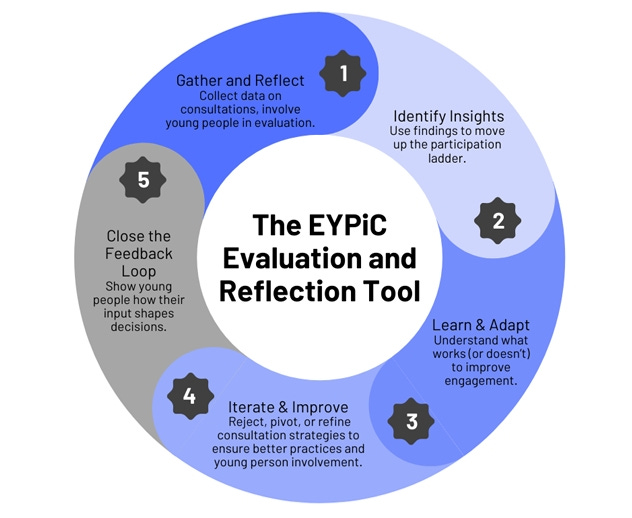
At its core, the toolkit encourages a shift in approach: using youth-friendly communication, integrating digital and creative engagement methods as well as in person options, and involving young people at every stage - from planning and design, through to delivery, feedback, and evaluation.
These are not just ‘nice to have’ changes. If we are serious about creating transport systems that are accessible, inclusive, and future proof, then young people need to be part of shaping them.
Having the opportunity to undertake this research, and work with young people and local authority staff to explore challenges and opportunities for improving the inclusive engagement of young people in local decision making has been a real privilege. Working with local people is always something I enjoy and also something that I feel is essential to ensuring that research is useful and impactful.
The findings and outputs from this research are just the start of the process to changing how consultation is practiced in England. There is a real opportunity here for transport planners, local authorities, and consultants to rethink how we include local voices in plans and policies – moving away from one-off, tick-box exercises towards ongoing, meaningful participation.
I am aware that lots of good work is already happening in this space, with creative agencies and organisations collaborating with local authorities to develop effective and inclusive ways for people to have their say. There are also more and more local authorities adopting place based methods and in turn working more closely with communities ahead of making decisions. But – we still have a long way to go.
I’m keen to hear how others are approaching more inclusive engagement of young people and other underserved groups. How are you ensuring that more people across our communities have a meaningful role in shaping transport and local decision-making?
If you’re working in this space and would like to collaborate or test new approaches, please do get in touch: info@bridgeresearchltd.com
You can access the EYPIC toolkit here: Engaging Young People in Consultations: Introducing the EYPiC Toolkit
🗓️ Events, My Dear Boy, Events
James here again. This is just a shout out that good friends and all-round general good eggs Susannah Walker and Joely Hill are part of an excellent event that the Transport Planning Society are delivering on 29th April in London called Designing Equitable Communities: Rethinking through a gender lens. You should get tickets to it. Also, if you can’t join in person, join online instead!