
🤦♂️ Oh No, Not Again
Barely a few weeks after being caught up in a road traffic incident and seeing the psychology of it all play out, I got caught behind another one.

Good day my good friend.
Two public service announcements for you today. Firstly, there will be no newsletter next Friday. I will be spending the week with my feet up in a converted barn in Norfolk. Or sailing on a Norfolk Broad. Or eating ice cream at the seaside. Regardless, I won’t be in front of my computer. So no newsletter.
Second, the deadline for signing up to the Transport Box project I mentioned two weeks ago has been extended. You can now sign up by Friday 12th June. As a quick reminder, by being part of this project you will get training and support throughout June, attend an in-person co-design session, and deliver a session with local children with Special Educational Needs and children accessing Child and Adolescent Mental Health services in July. The whole thing is worth around 7.5 hours of CPD focused on community engagement and social value.
🧠 The Psychology of Waiting
A few weeks back, I shared my story of being on the scene of a road traffic collision in Cambridgeshire. I shared my frustrations at how people reacted to seeing a man injured, and how it was an example of “motonormativity in action.” Little did I know that the psychology of how people react to road traffic incidents beyond their control would soon be staring me in the face once again.
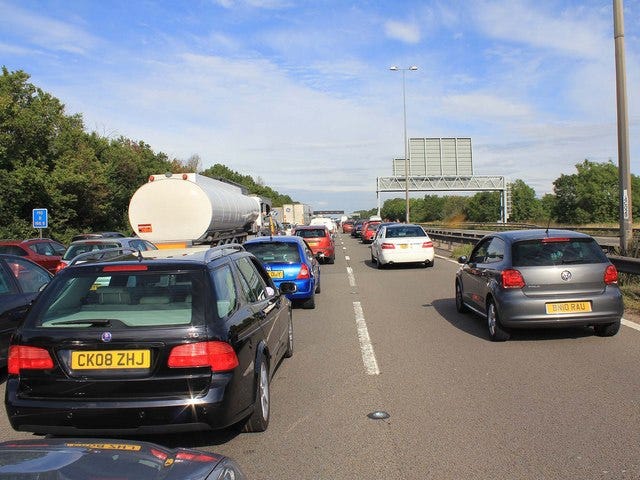
It started how you might expect. With a sea of brake lights. The traffic slowed in a ripple, in that way that you usually see on a motorway. One or two vehicles flicked on their hazard lights in case people behind them really didn’t get the message. It was just after 8pm on a sunny Thursday evening, on the M1 southbound just past Junction 23A near Nottingham. It had been a long day in Bradford, so long that the train was no choice unless I wanted to get back home close to 1am. I had driven that day, and that choice to head down the M1 put me on the path to experiencing traffic psychology first hand.
After about 15 minutes, it was clear we were not going anywhere. There was no traffic heading northbound, so the motorway had clearly been closed. Drivers ahead and behind me were switching off. Some opened their doors. A few stepped out and stretched, looking forward at a road that was not going to move for some time. One even got their dog out to stretch its legs.
Then, strangely, I spotted a woman walking up the northbound carriageway. This woman had parked her car carefully on the hard shoulder. From my position, I could not tell anything about her age or her circumstances beyond her demeanour. She was on her own. She was walking. She was in distress.
Well, not quite on her own. Two paramedics were following her, with I presume a third close behind in an ambulance. They were clearly trying to talk to this lady, and encourage her into the ambulance for her own safety. When they moved towards her, she would head up the grassy embankment. When they paused or pulled back, she would come down again. It was like a pebble being pushed along a beach by the waves. The paramedics pushing her up and along, and as they retreated she came down. Rinse and repeat.
You can probably guess from my experience at the road traffic collision in Cambridgeshire that I am not the kind of person who likes to stand idly by. But in this situation help, however well meaning, from anyone would have made things worse. The emergency services were close, they had an ambulance with them, and any movement from a stranger on the southbound side would only have added pressure to an already delicate situation. So I sat. I waited. I tried not to stare too obviously.
After what felt like a very long time, but was perhaps forty minutes, several police cars approached from the south. That must have been her cue, because once they approached she hopped into the ambulance without further invitation.
All through this, the overhead sign on our side of the road flashed its warning: Pedestrians on Motorway. A short time later, the motorway reopened.
The mood on my side of the road was less than generous. There was an overwhelming sense of confusion and frustration. Why is the motorway closed? For how long will it be closed? Some of them could not see what was happening on the other side of the road, or at least not as well as I could.
After about twenty minutes, the muttering started. A man two cars in front of me leaned on his bonnet and shook his head at me as he caught my eye, the universal gesture of “can you believe this.” Another, further along, kept walking up and down the lane between his car and the next one, phone pressed to his ear, giving a loved one a live and frustrated commentary. The guy next to me asked the question that was on everyone’s minds: “why can’t we just go? She’s over the other side!”
Then came the shouting. Just one or two voices I must stress, aimed across the central reservation, broadly in the direction of the emergency services and the woman herself. “Come on, love, get on with it,” I heard from one man leaning out of his car. “Just grab her and bundle her in” came another from someone in an SUV. Other voices, lower, agreed in murmurs.
I’m not sure my interjections into the conversation helped. While saying that the paramedics can’t just man-handle people and that the police have closed to road for our safety as much as hers is technically correct, its not reassuring.
Nobody, I should say, was cruel in any sustained way. I didn’t detect any real menace in what was said. It was the irritated frustration of people who had been stopped for an unknown reason for an unknown length of time. It was understandable, though not easy to listen to.
The bit of psychology most useful for understanding the irritation around me is the simplest. In 1939, a group of researchers at Yale led by John Dollard published a book called Frustration and Aggression. In it, they proposed what is now called the frustration-aggression hypothesis, which says that when our progress towards a goal is blocked, we experience frustration, and that frustration acts as a basis for aggression1. To us that sounds obvious, but someone, at some point, had to study it and codify it.
Sitting in a stationary car on a motorway is, in the language of this theory, almost a textbook example of goal blockage. You set out with a destination. You may have a meeting, a child to pick up, a train to catch, a relative to visit. The motorway is, for those few hours, woven into the fabric of your plan. When it stops, your plan stops, and you cannot move the obstacle yourself. It feels deliberate and unfair, and so frustration builds, seeding the ground for aggression - whether that be a sarcastic remark or something more sinister.
The closure was not, of course, deliberate or unfair. But in that time period between being blocked and finding out the reason, the brain does not know that. It just knows that the path is closed and that you are stuck.
A separate but related strand of research deals with how we experience waiting itself. Research by David Maister established principles of the psychology of waiting. This includes the observation that:
unexplained waits are longer than explained waits.
Lets use a public transport analogy here to show this. Two trains arrive ten minutes late at a station due to signalling failures, the first scheduled to arrive at 10:00 and the second at 10:20. For the first train turns up at 10:10, and all the time the departure screen showed the train as ‘Delayed.’ For the second train, the departure screen showed the estimated arrival time as 10:30, and gave the reason for the delay. It turns up at 10:30.
Both sets of people waiting for each train faced a similar extra waiting time. Yet for those waiting for the first train, each minute likely felt like five. For those waiting for the first train, each minute likely felt like two or maybe three. That is because their end goal is in sight (the new arrival time) and the reason for delay has been explained to them.
This was very much my experience on the M1. Until the lady walked into view, people did not know the reason for the delay. The frustration builds as each minute feels like an eternity. National Highways likely could not tell people of the reason for the delay in those few minutes because they were still diagnosing the issue themselves.
People are far more tolerant of long waits when they know how long the delay will last. In contrast, when no end is in sight, frustration grows exponentially. The exponential part matters. The first ten minutes might feel like twelve. The next ten feel like twenty. The next ten feel like an hour.
The body is not neutral about any of this. A systematic review in the journal Transport Reviews on the effects of congestion and delays on mental wellbeing notes that being stuck in traffic has been linked to left-hemispheric EEG activation associated with anger and worry, and that congestion and delays are “a source of road anger and frustration, so that they are not only likely to impact mental health/wellbeing, but also traffic safety.”
A more recent study describes traffic adversity as triggering the release of adrenaline and cortisol, the same hormones that drive the fight-or-flight response. The list of consequences it gives is long. Stress, anger, aggression, tension, impatience, frustration, helplessness. The last one is worth pausing on, because helplessness is often the underlying current beneath the visible irritation. You cannot do anything. You cannot fix it. In our case, you could not even leave.
When you put a body that is producing stress hormones inside a metal box with limited movement and no clear end point, you have made a pressure cooker. The lid stays on for most people. For some, the lid comes off as muttering or pacing. For a few, it comes off as shouting at a stranger across three lanes of motorway.
The other piece of the picture is the car itself. There is a body of work in psychology on what is called deindividuation, the loss of self-awareness and personal accountability that can come from being part of a group or feeling anonymous. Philip Zimbardo, in the 1960s, identified the conditions that tend to produce it:
Anonymity
Diffused responsibility
Group activity
Altered temporal perspective
Emotional arousal
Sensory overload.
If you read that list and think it sounds rather like a motorway in a long queue, you are not alone. Many of you have probably read Tom Vanderbilt’s book Traffic: Why We Drive the Way We Do, which made exactly this argument, and a piece in Slate summarises the point neatly:
When you look at Zimbardo’s description of conditions that contribute to a sense of deindividuation, it basically reads like a list of everyday road conditions.
Cars give us the illusion of being unseen. We can shout, gesture, swear, and the person we are shouting at cannot really see our face. The people who called across the motorway that evening would, I am fairly sure, never have shouted those words at a woman they passed in the street. They were not bad people. They were people in cars, in queues, in stress, in groups, in an unexplained delay. They were, in the language of the literature, deindividuated.
As if to prove the point further, an experimental study published in the Journal of Applied Social Psychology, found that participants in a driving simulation drove more aggressively when their identities were concealed than when they were identifiable. The effect was modest but real. Anonymity, in a car, makes aggression a little easier.
While the people in the queue on my side of the motorway were wondering when the road would open, the people on the northbound side were doing something that takes time. While just clearing up the problem sounds fine in theory, the reality of dealing with emergencies is more nuanced than most believe it to be.
When a person walks onto a motorway in distress, the response is governed by clear principles. The first is obvious - preservation of life, both the person’s and that of any responder. The second is to slow everything down. The College of Policing’s guidance on suicide prevention and response sets out the role of officers in offering crisis intervention and approaching such incidents in a “standardised way.” Standardised does not mean fast. It means careful.
Initiatives like Merseyside Police’s Operation Copenhagen, formed with the local authority, National Highways, Wirral MIND and Samaritans, recognise that motorway bridges and carriageways are recurring locations for people in crisis. The work involves more than retrieval. It involves engagement, often with a single officer or paramedic in slow, unrushed conversation, while colleagues maintain a wider perimeter and other vehicles are kept at a distance.
The Independent Office for Police Conduct, in a learning lessons publication on mental health responses, describes an incident very similar to the one I watched. A woman, alone on a motorway hard shoulder, in visible distress, with members of the public calling police because of an “immediate risk to life.” Officers attended. They located her. They took her to hospital. The mental health crisis team arranged an assessment. It is, on paper, a short paragraph. In life, it was slow, methodical, and careful.
The pattern I saw, where she headed up the embankment whenever responders came close, has its own logic too. A person in crisis often experiences the approach of others as pressure. Movement away is not necessarily refusal of help. It is, sometimes, a way of holding ground while the rest of the brain catches up. Responders trained in this work know to read it. They retreat, regroup, and approach again. They do this, in some cases, many times. Twenty minutes of this looks like nothing happening to a distant observer. It is not nothing. It is the work.
Such situations necessitate road closures. I should not have to explain this to you I am sure, but this kind of situation unfolding with traffic roaring past at seventy miles an hour means there is no margin for error. A distressed person getting spooked and running into the live traffic lanes of an open motorway would likely lead to only one outcome, and for those frustrated at being delayed for an hour it would also mean a delay much longer than that. Closing the motorway, even for an hour, is what gives the responders the space to do the slow and necessary work.
I want to be careful here. I do not know who the woman was, what brought her there, or what happened to her after the ambulance sped off. From my vantage point all I saw was her in distress - it was about the most I could make out across three lanes, a hard shoulder, and a central reservation. I hope she is alright.
I hope the people who helped her have her, by some route, in the right hands. The BBC has reported many incidents of motorway closures across the UK in recent years for what police describe as welfare checks or concern for a vulnerable person, including one near Watford and one near where I live in Bedfordshire. Most do not become news stories beyond a paragraph about reopening times. Each one, though, is somebody’s worst day.
After about an hour, the officers from National Highways signalled to the vehicles at the front of the queue that our side was now open. There was a mini-mad dash from several people to their vehicles. The engines started and we were rolling. As my journey restarted, I could see the rolling road block on the northbound side finally getting things moving.
All of the shouting and muttering was gone. Replaced by conversation between friends and family, or in my case a Green Day CD. Most drivers will have driven off and not given the woman another thought, because that is how a busy life works and there is no shame in it. But for a moment, there was a sense that something had passed.
I want to be sympathetic to everyone here, because I think everyone deserves it.
The people who shouted were not villains. They were likely tired, stressed, late, anxious, and unable to see or understand what was going on. The psychology of their reaction is well documented, and I must admit that despite my own knowledge of this, the pangs of frustration did rise in me once or twice. Most of us are not very good at being in queues with no end in sight. Our bodies object before our minds catch up.
The emergency services were not slow. They were doing their job in exactly the way they are trained to do it, which is to say carefully. Speed is the enemy of good outcomes in this kind of work. The hour they took is the hour the woman needed, and the hour the public did not realise was being spent on her behalf.
The woman was not selfish. People in crisis on motorways are not making a logical decision, and are certainly not thinking about other people’s journeys. They are, by definition, people for whom the ordinary fabric of decision-making has come apart in some particular way. The fact that a motorway closure ripples out into the lives of thousands of strangers is a feature of how traffic works and how we manage our road network, not of her choices.
If there is anything to take from an hour spend stood on a closed motorway, it is perhaps this. The next time the motorway closes for an unexplained hour and the air starts to fill with sighs, it is worth remembering that one reason the traffic stops is because lives are being attended to. The body’s frustration is real, and the psychology behind it is real, but so is the work happening half a mile up the road.
Sometimes sitting in a car and watching, and choosing not to add to the shouting, is helping in a small way. Sometimes the most useful thing strangers can offer a person in crisis is simply not making the moment any worse than it already is. Doing nothing is, in such situations, doing a lot.
On a serious note, if you are struggling, the Samaritans can be reached at any time on 116 123 in the UK and Ireland, or by email at jo@samaritans.org. SHOUT, a 24/7 text service, can be contacted by texting SHOUT to 85258.
👩🎓 Latest Research
The clever clogs at our universities, government departments, and other clever people have published the following excellent research. Where you are unable to access the research, email the author – they may give you a copy of the research paper for free.
You may have also noticed that I am shifting this section more towards the subject matter in the main part of the newsletter. 😉
Driver mental workload measurement trends and cognitive impacts
TL:DR - A review of 59 studies published between 2020 and 2025 on how driver mental workload is measured, covering subjective reports, physiological measures, behavioural indicators and hybrid machine-learning approaches. The key takeaway is that both overload and underload matter: high workload can impair hazard detection and lane control, while underload in automated driving can reduce situational awareness.
TL:DR - This paper looks at psychosocial risks in road transport work and uses implementation science to identify where current practice falls short. It is road-safety-adjacent rather than classic “driver cognition” work, but it fits the broader traffic psychology field because it addresses how working conditions shape driver wellbeing, risk and behaviour.
TL:DR - A simulator study with 30 young male participants comparing manual, Level 2 semi-automated and Level 4 automated driving. The study found semi-automation improved hazard detection sensitivity but increased physiological cost, and that high interpersonal trust was linked to slower reaction times under semi-automation — described as a “social complacency” effect.
TL:DR - This study models driver anger across multiple intensity levels using driving performance and physiological signals. Rather than treating anger as simply present or absent, the authors use a two-stage machine-learning approach: first detecting anger, then classifying its intensity.
Driver mental workload and automation: real-time monitoring is becoming the centre of gravity
TL:DR - One clear theme from the workload review is that the field is moving towards real-time, multimodal and ethically grounded workload detection systems that combine cognitive, emotional and contextual information.
😀 Positive News
There has been some positive news in the field of traffic psychology recently. And the M1 is nowhere to be seen.
Cycling UK calls for a new Highway Code awareness campaign
Four years after the Highway Code was updated to introduce the hierarchy of road users, Cycling UK called for a renewed THINK!-style campaign so drivers actually understand rules around safe overtaking, junction priority and opening car doors safely with the “Dutch Reach”. The positive news here is that the campaign is not framed as cyclists versus drivers, but as a practical way to reduce uncertainty and conflict in shared spaces, especially for people walking, wheeling and cycling who often carry the stress of negotiating with faster, heavier vehicles.
ROADPOL’s 2026 Safety Days will focus on pedestrians, not just drivers
ROADPOL announced in April that its 2026 Safety Days campaign, running from 16 to 22 September, will focus on pedestrians as one of Europe’s most vulnerable road-user groups. The campaign’s emphasis is refreshingly practical as it focuses on more attentive driving near crossings and busy urban areas, better speed management, improved lighting, clearer road design, safer crossings, traffic calming, pedestrian zones and wider use of lower urban speed limits.
Behavioural researchers say the new GB strategy could turn policy into real safety gains
Behavioural Research UK published a piece in May arguing that the GB Road Safety Strategy will only work if behavioural research is built into delivery, because almost every action either directly targets behaviour or assumes behaviour will change. That is a positive sign because it moves the debate beyond slogans and into implementation.
💻 Hard Work
My work this week has focussed primarily on not getting fried in this unexpected heatwave, and a few odd jobs ahead of heading to Norfolk. This has meant doing a lot of promotion of the Transport Box - you should sign up and the deadline for sign ups has extended to 12 June!
I have also been in sales mode on Mobility Camp - talking to people about sponsorship and how they can get involved in Mobility Camp. If sponsoring a fun, innovative, and unconventional transport event sounds good to you, you should drop me a line!
Finally, I have been planning for an Evidence Safari for Bradford Council. This means working with a bunch of very clever people at the Council and its Health Determinants Research Cluster to gather together evidence on transport’s impacts on areas as varied as health and the needs of young people. As well as the practical logistics of it all.
🎶 Musical Finale
Bad Habit by The Offspring is probably the best song about road rage and psychosis triggered by traffic that has ever been written. The lyrics are written with a lot of dark humour, so you have been warned.
🪧 Notices
Yes, a new section to the newsletter. This section is intended to notify you of important things that may or may not annoy you, depending on your view of the world. But these are things I feel it is worthwhile pointing out.
Regarding Artificial Intelligence. For my newsletter, I use AI like a research assistant. I get the AI (in my case Claude Opus 4.7) to find for me well-cited and evidenced research in the subject matter, focussed on academic journals with a high impact factor. I follow this up with my own research, and I check each source myself. Where I have the time to, I contact domain experts or seek out their published works to validate the findings. The words written here are my own, spelling mistakes and all.
Regarding my expertise. I am a transport planner, so my realm is public policy, how people and things move, and their impacts. While I research everything in a manner I consider robust, there may be some instances where my lack of domain expertise fails me. That’s on me, but that’s all part of learning. I always encourage any reader to do their own research on the subject matter.
✅ Sign Up
If you have been sent this newsletter, please consider signing up. Its free, and I don’t spam your inbox with random rubbish - just my own words.
Though this is not the only possible outcome, it should be stressed, and later work by the same authors and others demonstrated that aggression is just one of many possible outcomes.
A great exploration of a road crisis, the emergency teams involved & their actions, and the psychology of waiting (with supporting studies). Thank you James.