
🍽️ Culture eats Strategy for Breakfast
I review the first transport strategy I ever wrote to ask whether it succeeded or not. Spoiler alert: its a mixed bag.

Good day my good friend.
I need to start with an announcement. As part of my work on Mobility Camp, I am working with UK Unplugged on delivering a project aimed at improving engagement with young people with educational needs and mental health issues - the Transport Box! And we want you to be part of it.
There are more details on the Mobility Camp website, but in short if you want to develop some public engagement skills with a hard-to-reach group, and you can get to Stockport or Leeds easily, this will be for you. We need you to sign up by 30th May at the latest. And yes, I WILL be mentioning this a few more hundred times.
Anyway, go sign up!
There’s something strange about reviewing a document you helped write. You remember the meetings, the arguments, the compromises, the late nights trying to make the numbers stack up. You remember what didn’t make it into the final version and why. And you remember the genuine excitement of producing something you believed in — even as you quietly wondered whether any of it would actually happen.
Central Bedfordshire’s Local Transport Plan 3 was adopted in April 2011. It covered 15 years — from 2011 to March 2026 — and it was, as I keep reminding people, the first ever Local Transport Plan this authority had produced. We were a new unitary authority, created only in 2009 from the former Mid Bedfordshire and South Bedfordshire districts. We had a blank sheet of paper, a tight budget, and a genuinely exciting opportunity to set the strategic direction for transport across a large, complex, predominantly rural area for the first time.
Now, as LTP3 reaches the end of its intended lifespan and LTP4 begins to take shape, I think it’s worth being honest about how it went.
One of the things I’m still fond of is the decision to organise the plan around journey purposes rather than modes of transport. It sounds like a subtle shift, but it changed how we thought and talked about investment.
The conventional approach — and plenty of plans even now still do it — was to divide transport into its component parts. Usually roads, buses, rail, cycling, walking, freight. Each gets its own section and its own targets. The result is a fragmented strategy that tells you how each mode is performing but rarely asks the more fundamental question: are people actually able to get where they need to go?
We asked that. Why do people travel? To work, to school, to the doctor, to the shops, to see friends and family, to move goods around. We structured the objectives around those purposes, and it opened up multi-modal thinking. You stop defending bus subsidies in isolation and start thinking about which combination of footway improvements, real-time bus information, and workplace travel planning will actually make it easier for someone in Houghton Regis to get to their job in Luton without a car. At least, that was the theory.
It also made the plan an easier political sell. Transport for its own sake is a hard sell in a tight budget environment, especially in an environment where anything seen as restricting car use was part of a “war on the motorist.” Transport as the thing that gets people to jobs, to hospitals, to schools — that’s a much easier conversation to have with elected members.
I still think the framework was broadly the right one. What I’m less sure about is whether it was followed through on in the delivery phase — particularly in rural areas where the journey-purpose approach revealed the sharpest gaps but the money was thinnest.
The Luton–Dunstable Busway isn’t something I can take credit for in full — while I helped with the business case it was already in development when we were writing LTP3, and Luton Borough Council were the Project Sponsor. But embedding it centrally in our plan, and tying our objectives to its success, while ensuring the wider network of improvements in Dunstable and Houghton Regis was designed to connect with it — that was deliberate, and it mattered.
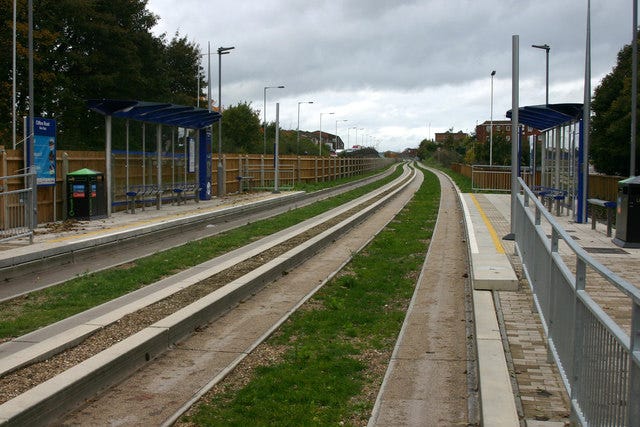
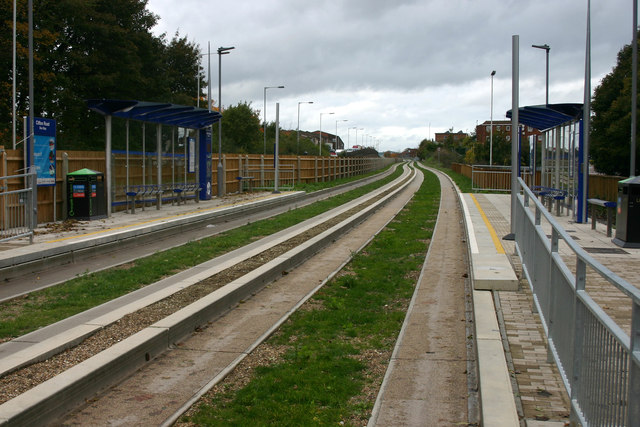
The busway opened in September 2013, five months late and substantially over its original £51 million budget (it came in at £91 million, driven by underground utilities, soil contamination and Japanese knotweed, which as any gardener knows is a nasty thing to get rid of). At the time there were people — including, I’ll admit, some within the industry — who were sceptical. Guided busways have a chequered history, and Luton and Dunstable are not the most obvious candidates for rapid transit. This was not helped by the fact that the same contractors who delivered the Cambridgeshire Guided Busway - with its issues with poor construction - were appointed to construct the Busway.
But it worked. It now has over two million passengers a year riding on it. And its still running more than ten years on. The route gives Dunstable and Houghton Regis residents a genuinely fast, reliable connection to Luton Airport, Luton town centre, and onward rail services in under 30 minutes (its close to an hour in peak times on the main road). And alongside the guided track, there’s a cycleway that around 500 people a day now use — something I don’t think any of us predicted would happen, but which exemplifies exactly what we were trying to achieve with the integrated approach.
There are still gaps. Local politicians have rightly noted the lack of an extension to Leighton Buzzard at the western end, which would support development and would give busway users a direct interchange with the West Coast Main Line. That extension was always an aspiration rather than a commitment in LTP3 — we were realistic about what the funding envelope could support — but it remains a missed opportunity.
If the busway was the headline public transport win, the A5–M1 Link and Woodside Connection were the headline highway wins. And I won’t pretend the timeline wasn’t frustrating.
We knew the A5 through Dunstable town centre was a serious problem when we were writing the plan. Thousands of vehicles a day — including significant HGV traffic — running through the historic high street, causing congestion, air quality issues, and making it difficult for Dunstable to develop as a town centre in its own right.
As someone who is pro-sustainable transport, you would expect me to say that we should have chosen to invest significantly in public transport and active travel. And in the Busway, we did with the former. But sometimes you have to look at the situation and realise that just maybe, a bypass can help by tackling the fundamental issue. In the case of Dunstable, the A5 through the town was a major strategic road (owned and operated by Highways England) with a lot of movement straight through the town. Movement not easily shifted into other modes. So the solution was clear: a northern bypass connecting the A5 to the M1 at a new Junction 11A, with the Woodside Link providing access from the industrial areas of Dunstable and Houghton Regis.
In LTP3 we expected construction to start in 2014/15. The Public Inquiry had been postponed by the Coalition Government in 2010, and the scheme was delayed further by the usual combination of funding negotiations, procurement, and statutory processes. Both the A5–M1 Link and the Woodside Connection ultimately opened in spring 2017 — about two to three years later than we’d expected.
But they opened. And the impact has been real. The 7.5-tonne weight limit on local roads through Dunstable and Houghton Regis — the thing that actually gets the lorries off the High Street — became possible because the bypass existed. Dunstable’s town centre regeneration could begin to take shape. The industrial areas got the motorway access they needed without routing HGVs through residential neighbourhoods.
Occasionally I drive through Dunstable, and the impact is very visible. On Hockliffe Road leading into Dunstable, traffic reduced by around 61% according to National Highways. Most roads in Dunstable have seen traffic reductions between 20% and 60%. That’s what we were trying to do. It took longer than I’d have liked, and the frustration of watching those delays was real. But the outcome is the right one.
I remember the conversations about East–West Rail in the early planning stages of LTP3. There were people who thought including it was optimistic to the point of wishful thinking — a scheme that had been discussed for years, with a chequered funding history and formidable political and engineering challenges. My view then, and it hasn’t changed, is that you have to back the right infrastructure even when it’s hard to deliver. And East–West Rail is the right infrastructure.
We pointed to a benefit-cost ratio of 5:1 and described the case as “exceptional.” That wasn’t spin — the economics of the project genuinely are strong, and the connectivity benefits for Central Bedfordshire, particularly for the Marston Vale communities, are significant.
Now, in 2026, East–West Rail is slowly moving. Freight services began using the Bicester–Bletchley route in June 2025, but progress with passenger trains is frustratingly flow. The government has committed £240 million to the Bletchley–Bedford works, with an Oxford to Bedford passenger service targeting the end of the decade. The Bedford–Cambridge section is still contested, but it’s funded and in statutory consultation.
This is not the 2026 outcome LTP3 envisaged. I had hoped the Marston Vale line improvements would be further advanced by now, and the proposed consolidation of existing stations into four new ones will be controversial — communities that have grown around their local station will understandably push back. But the direction is right, and the momentum now feels different from what it did five or ten years ago.
I wish I could say the same about the Wixams station. I won’t gloss over this one. We included a new station on the Midland Mainline between Bedford and Flitwick at the planned development at the Wixams in LTP3 with a planned completion date of 2014. A new 4,500-home community being built on the Elstow Storage Depot site, straddling the Central Bedfordshire and Bedford Borough boundary, with a station on the Midland Main Line as the cornerstone of its sustainable transport provision. The logic was sound. The station was supposed to come first, or at least early, so that residents moved in with a train service rather than entrenching car dependency from day one.
It didn’t happen in 2014. It still hasn’t happened now. The houses are being built on the Wixams and at two further housing sites close to Houghton Regis, and the station is still not there. Funding was withdrawn by Network Rail. Years of negotiations followed. Construction finally began in September 2024 — a decade late — and was on track for a 2026 opening. Then the potential Universal theme park development nearby triggered a pause, with around £28 million already spent. There is no confirmed timescale on its opening. The delivery of this station is now critical for the delivery of Universal Studios, and Universal has spades in the ground now. No such movement on the station, though.
This is exactly the kind of outcome that makes you question whether the planning system is really designed to deliver sustainable communities or just houses. The transport infrastructure that was supposed to underpin the new settlement has been repeatedly deprioritised, delayed, and is now caught up in a completely separate commercial development that arrived long after the housing was built. Residents of Wixams have been living there without the station they were promised for years. There is a very real chance that Universal Studios will open, and people will have to be bussed to the theme park from Bedford station.
That’s a failure, and I think it’s important to name it as one — even when it’s uncomfortable to do so about something I helped plan.
Away from the big-ticket projects, a lot of LTP3’s actual delivery happened through the Local Area Transport Plan programme — and I think this is underappreciated.
We committed in the plan to producing LATPs for the whole authority, starting with the four main growth areas and rolling out over time. Eleven LATPs were ultimately completed. Each one involved genuine community engagement, local scheme identification, and a funded programme of delivery. Bus stop improvements, cycling infrastructure, safe routes to schools, shared space in town centres, pedestrian crossings, public transport information — not glamorous, but real and tangible.
The “myjourney” branding we developed for the consultation and engagement process was something I was particularly invested in. The idea was to give the plan a human face — to make transport feel personal rather than technical. Transport isn’t about infrastructure, it’s about people getting to the things they need. Whether it fully landed with the public is debatable, but it helped us reach audiences that dry planning documents typically don’t.
What the LATP process also did was force us to have honest conversations at a local level about priorities. With £1.26 million in the Integrated Transport Block for 2011/12, covering the whole authority, you can’t do everything. The LATP framework gave communities ownership of what would be prioritised in their area, and it gave the authority a defensible, evidence-based basis for those decisions. I look back at that structure and still think it was the right one, even if its ability to deliver was questionable.
I’d be doing a disservice to anyone reading this — particularly anyone working on LTP4 — if I didn’t say honestly where I think we fell short.
The smarter choices ambition was probably too high. We leaned heavily on DfT research suggesting that well-implemented smarter choices programmes could reduce urban car use by up to 21% in peak hours, and our positive experience with the Leighton-Linslade Cycle Demonstration Town. That research was real. But Central Bedfordshire is not an urban authority — it’s a predominantly rural one, with dispersed employment, limited public transport outside the main corridors, and long average commute distances. The conditions for smarter choices to work at scale simply aren’t present for most of the authority. I don’t think we were always honest enough with ourselves about that gap when we were writing the targets.
We also relied a lot on developer contributions, which cannot substitute for strategic funding. The logic is sound — development generates travel demand, so developers should fund mitigation. But contributions come in when permissions are granted and development proceeds, and they’re often tied to specific sites. The cumulative impact of multiple developments across an area isn’t neatly mitigated by site-specific contributions. Communities in growth areas felt the pain of additional traffic before the mitigations arrived. That’s a legitimate grievance, and I think we underestimated how acute the timing problem would be. Not helped by the fact that the planning system has been radically reformed over the last 15 years.
I also feel we could have been bolder on freight. The Designated Road Freight Network and freight strategy were sensible and necessary. But freight is an area where stronger ambition — more rail freight, better last-mile logistics, more pressure on developers to locate logistics-intensive uses near strategic road access — could have reduced the impact on communities more meaningfully. I think we were too cautious.
Bus services outside the main corridors remained, and still remain, fragile. We set a target of growing bus passenger journeys by 41% over the plan period, much of it driven by the busway. The busway delivered, but we did not meet the target at all. The rural and interurban bus network has faced ongoing commercial pressure, route withdrawals, and subsidy cuts that the plan couldn’t fully protect against. For many villages in Central Bedfordshire, bus services are thinner now than they were in 2011, and some have had their services withdrawn entirely. That troubles me.
LTP4 is in development, covering 2026–2040. I’m not directly involved in that process, but I’m watching it with interest — and some familiar anxieties.
The challenges LTP4 will face are, in many ways, the same ones we identified in 2011. Car dependency remains deeply entrenched. Housing growth continues to outpace transport investment. Rural communities have needs that don’t fit neatly into traditional cost-benefit analysis. And the decarbonisation imperative, which was present but relatively modest in LTP3, is now a central strategic challenge that can’t be ignored.
What’s different is the funding context — potentially for the better, with East–West Rail now backed by serious government commitment, and active travel funding streams that didn’t really exist in 2011. And the institutional maturity is different. Central Bedfordshire now has fifteen years of experience as a unitary authority managing its own transport network.
The politics of the place is one of flux. A long-held Conservative stronghold on the Council was broken by a coalition of independents in 2023. In a by-election in Stotfold in September 2025, Reform won a seat from Labour, and are expected to perform strongly in the next elections in 2027. Whether this will affect the new LTP remains to be seen.
I hope LTP4 builds on what worked in LTP3. Namely the integrated thinking, the journey-purpose framing, the honest engagement with communities about what’s realistic. And I hope it’s bolder in the areas where we were cautious — particularly on sustainable travel in rural areas, on freight, and on the kind of long-term infrastructure commitments that take a decade to deliver but are right to start now.
If you asked me to mark LTP3 on how well it has achieved what we set out to do, here’s what I’d say.
We set out to produce a coherent strategic framework for transport in a new authority, centred on some critical major schemes, and build a local delivery mechanism that reflected community priorities and worked within genuinely tight financial constraints. Broadly, we did those things. The major schemes we championed — the busway, the A5–M1 Link, East–West Rail — were the right calls. Two delivered within the plan period, one is finally in delivery. The LATP programme produced real, tangible improvements across the authority. The journey-purpose framework gave the plan a coherence and community relevance that I think was genuinely distinctive for its time.
Where I’m less satisfied is in a few areas. Namely the behaviour change ambitions were too optimistic for the context, the delivery of sustainable transport alongside housing growth was too uneven, and some of the communities we most wanted to serve — rural, car-dependent, without strong public transport — are still waiting for something the plan promised them in principle but couldn’t fully deliver in practice.
That’s the nature of transport planning. It’s incremental, it’s slow, and it’s shaped by forces — national funding decisions, commercial operators, planning appeals, political cycles — that you can never fully control. The test isn’t whether every commitment was delivered on time and on budget. It’s whether the authority and its communities are in a better place now than they would have been without the plan.
I think they are. But I’m also aware that I’m not exactly a disinterested judge.
👩🎓 Latest Research
The clever clogs at our universities, government departments, and other clever people have published the following excellent research. Where you are unable to access the research, email the author – they may give you a copy of the research paper for free.
Decarbonizing emissions from last-mile deliveries in Chinese cities
TL:DR - The authors estimate last‑mile delivery emissions across 365 Chinese cities using data from 14 billion orders and 1.9 million couriers, which gives the study unusual scale and resolution. The headline finding is encouraging: order volumes rose by 83.5% from 2023 to 2024, but emissions increased by only 31.3%, suggesting delivery systems can become more efficient rather than scaling emissions linearly with demand. The paper also finds that smaller cities can have per-order emissions up to four times higher than larger cities because of lower delivery efficiency, and its mitigation scenarios suggest emissions could be cut by up to 84.2%.
Cycling accessibility and equity: a systematic literature review
TL:DR - This is a PRISMA-based systematic review of 71 peer-reviewed studies on cycling accessibility and equity, covering bicycles, e-bikes and bike-sharing. The review proposes a framework that links accessibility measurement to different equity concepts, including egalitarian vs sufficientarian approaches and horizontal vs vertical equity.
TL:DR - This uses a mixed-methods approach combining attitude analysis, surveys and field observations to examine how university students understand the social side of sustainable transport, including equity, accessibility, health and safety, individual responsibility, integrated planning, and cultural values. The study reports that female students accounted for 60% of bicycle users, that 73.2% of cyclists came from middle- and low-income groups, and that 47.3% of participants used bicycles for short distances.
Navigating ordinary hybridity in urban transport: the role of ‘4 + 1’ vehicles in Maseru, Lesotho
TL:DR - The study looks at the ‘4 + 1’ system in Maseru, where private cars carry four passengers in addition to the driver, and argues that it should be understood as an ordinary and integral part of urban mobility, not simply a policy failure. The paper finds that the system provides affordable, accessible and reliable mobility, especially for underserved areas, and also contributes to income generation and employment.
TL:DR - Rather than imagining autonomous mobility as a stand-alone future system, the paper explicitly frames it as a complement to existing transport networks. The proposed framework rests on three pillars — community-based operations, ultra-flex service, and an adapted autonomous mobility system — and tries to achieve equity through a three-ring spatial model, tailored autonomous driving classifications, low-cost vehicle-to-everything (V2X) deployment, and a government-enterprise-community governance model.
😀 Positive News
Here are some articles showing that, despite the state of the world, good stuff is still happening in sustainable transport. So get your fix of positivity here.
TfL restores bus frequencies on multiple London routes
From Saturday 25 April 2026, TfL says routes 6, 16, 27, 36, 46, 55, 56 and 95 all received timetable changes with frequencies restored, including improvements during daytime, evening and weekend periods on several routes.
Tilehurst gains full step-free access to all platforms
Network Rail announced that passengers at Tilehurst are now benefiting from step-free access to all platforms for the first time, following the installation of three new lifts and a new walkway between the car park and platform 1.
Beeston station transformation combines accessibility, cycling and service uplift
Network Rail said a celebration event marked the transformation of Beeston station after more than £7.6 million of investment, including a refurbished historic canopy and waiting shelters, while East Midlands Railway added a new cycle shelter, extra seating, improved lighting and a remodelled forecourt.
Hampden Park footbridge reopens after refurbishment, with accessibility upgrades
The reopening of the Victorian footbridge at Hampden Park station in East Sussex is another good example of practical, positive investment. Network Rail says the bridge has reopened after a three-month refurbishment, with new stairs and decking, stronger materials, improved slip resistance, upgraded handrails, safety mesh and a renewed protective coating to extend the structure’s life and reduce future repair needs.
Lagos Unveils 2050 Transport Vision, Shifts Focus to Integrated Mass Transit System
Lagos is explicitly shifting away from “roads first” thinking and toward integrated mass transit. According to the official LAMATA summary, the updated plan will anchor the city’s future around rail expansion, Bus Rapid Transit (BRT), ferry services, cleaner-energy buses, and improved last-mile access.
💻 Hard Work
I already mentioned the launch of the Transport Box at the start of this newsletter. Last week, I also got the chance to talk about Forest City with students from the University of East Anglia. They presented ideas on how to bring a cultural element to the city, and their ideas were far better than anything I could have come up with at University!
The long weekend was mostly dog walking, but I had great fun in my first game of Walking Football at Maulden Walking Football Club. Its actually refreshing to play football with people who do it just to have fun, rather than the competitive streak that is now found in 5-a-side. No goals for me, but then again my style of play has always been more Rio Ferdinand in his prime than Erling Haaland.
🎶 Musical Finale
This wormed it way into my ears last week on a long drive to Yorkshire, and its remained in my brain since then. Dilemma by Green Day is about the struggles with addiction faced by their lead singer, Billy Joe Armstrong. I like it not because of its raw lyrics, but because it is a classic Green Day banger.