
📈 Computer Says Yes
After nearly a century of knowing it exists, and it being codified in guidance for half a century, there is so much we don't know about induced demand. With disastrous results.

Good day my good friend.
This week’s post is about a report that was in my pre-holiday reading that never happened pile. Sitting alongside about thirty books collected at various charity shops and second-hand book stores. I don’t say this to boast, but more to say that not enough time is dedicated to reading.
This year, Mobility Camp is coming to Sheffield on 30th September, and it promises to be another amazing day of discussion, debate, and taking action. Anyone with an interest in transport should be there, and so should you. You can get tickets here.
I have driven this route hundreds of times, to the point where I can probably do this in my sleep. After crossing the motorway at Junction 12, you hit Toddington, a pretty Bedfordshire village whose streets are traffic calmed by lines of parked vehicles on either side of the road. Which is always fun for the bus. As you exit the village again, the All Saints Church passes on the left, which has sat on this Bedfordshire hillside since at least the 12th Century. The church garden is lovingly tended to, and the bell tower casts a long shadow in the afternoon sun.
Then, its a sudden right-hander before dropping quickly down the hill. If you have a passenger, they can see across the valley towards the northern reaches of Houghton Regis, with fields of cereals coating the hillside leading towards a horizon marked by new homes, telegraph poles, and electrical wires. You as the driver, however, are fully concentrated on the downhill, which hangs a sharper-than-you-think left at the bottom.
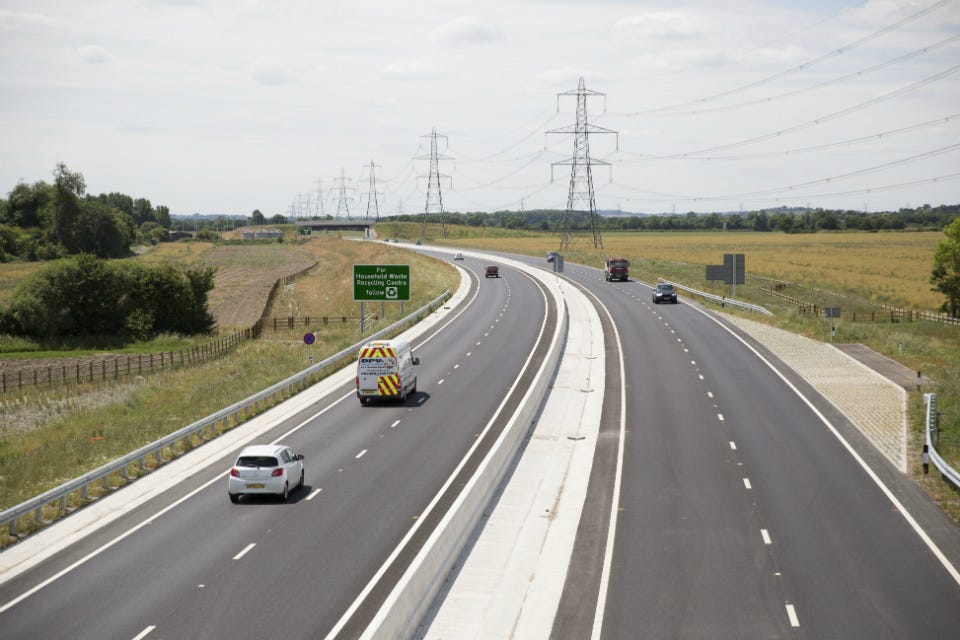
A short way on, I flick the indicator and turn right. Today, I am taking some things that were previously gathering dust in the shed for recycling or reuse at the Recycling Centre at Thorn Turn. When I was just out of university and heading to my first job - a Planning Trainee at South Bedfordshire District Council in Dunstable - I drove this route every day. Cutting along Thorn Road was a popular rat-run for those of us wishing to avoid congestion at the lights in the centre of Houghton Regis. Except I am not going this way. I have not turned onto a small country road1, but instead I am on a dual carriageway.
The Dunstable Northern Bypass - or the A5 to M1 Link to give it the official title - was a key part of the first Local Transport Plan I ever helped write. We at Central Bedfordshire Council identified that this scheme, proposed by the Highways Agency at the time, achieved a number of aims:
alongside the Luton and Dunstable Busway, it would reduce chronic traffic congestion in the centre of Dunstable by taking through traffic (especially HGVs) off the A5 through the town, and instead directing them to the M1 to complete the same trip;
unlock major housing growth planned to the north of Houghton Regis, which our modelling at the time indicated could not be delivered without radical traffic reduction within Dunstable;
improve east-west connectivity by providing a more direct link between the A505 to the south of Leighton Buzzard and the M1.
Driving along it now, it is quite stark on how not busy the A5-M1 Link is. In March 2025, the 5 Year Post-Opening Project Evaluation was published by National Highways, and one paragraph on page 14 provides some validation to this casual observation:
Overall, the project’s appraisal assumed larger changes in traffic than what was observed. The assumptions that underpin the traffic model could have been a factor in the forecasts it produced. The traffic model incorporated assumptions about economic developments and traffic patterns in the area, which could generate more traffic which would use the A5-M1 Dunstable Northern Bypass and the surrounding road network.
When you delve into the data, a variable picture emerges. While some routes saw changes in traffic levels that were less than forecast, others saw more. The B579 Luton Road was completely out - where the traffic model predicted increases in vehicles, the observed impact was in fact a decrease in vehicles.
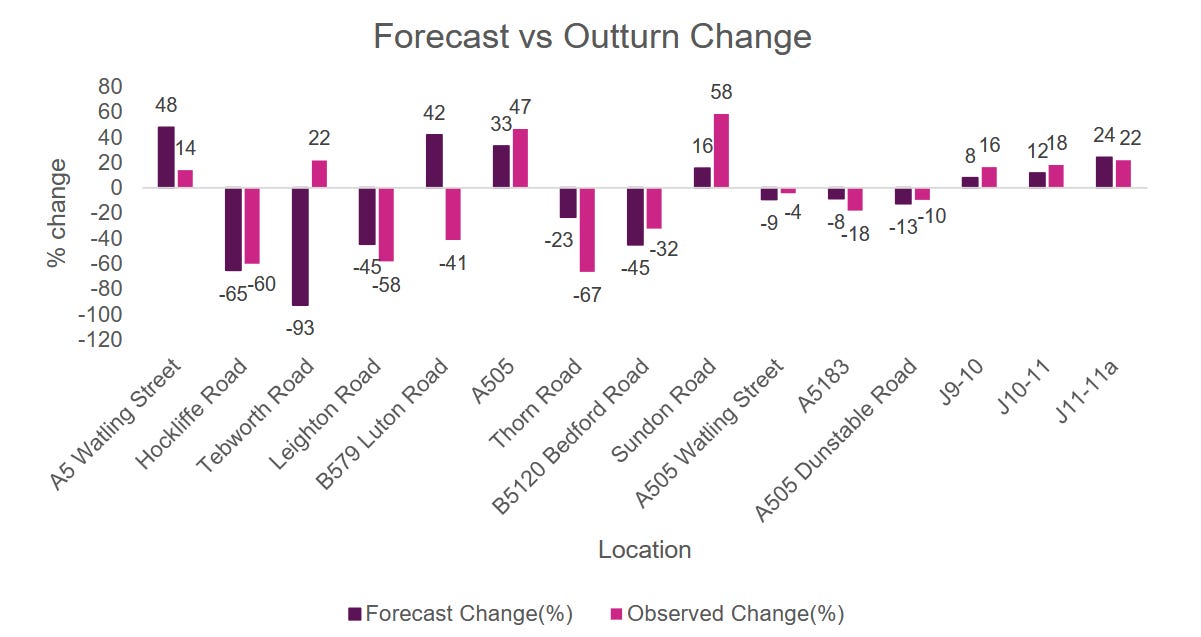
The report contains some health warnings. Some of the traffic count data on the A5 was missing, for example, and this needs considering when interpreting these results. Additionally, changes in traffic levels on the M1 between Junctions 9 and 11a were used as a proxy for changes in traffic owing to the scheme, which are affected by numerous other factors affecting demand on the M1 corridor, notably the completion of managed motorway schemes in the area.
I know what you might be thinking. This is another example of traffic forecasts over-estimating the benefits of a scheme. However, I see it differently. I see this as a failure to understand nuance when it comes to forecasting and induced demand. And to help make this point, I am going to draw on the findings of a recent think piece published by Dr Phil Goodwin to make my point, as well as provide some commentary of my own.
Before doing so, I should state right now that Dr Goodwin’s work builds a lot upon economic theory and its application to transport. While I know enough about this to be able to understand an economic case and be able to identify appraisal results that are obviously questionable, transport economics is not my specialism. I approach this as someone more based on the practice side of transport planning as opposed to operating detailed calculations of benefits. Bear this in mind.
What Dr Goodwin’s work usefully does is separate out the ideas of induced demand and induced traffic. The latter is very simple: its extra vehicle traffic. But the former considers changes in the level and structure of the demand for movement, of which induced traffic is just a part of this. In other words, induced traffic concerns itself with the amount of vehicle traffic on a road, and induced demand concerns itself with how demand changes as a result of social and economic changes brought about by the scheme. The former is more static, the latter is variable.
This challenge is central to how we appraise schemes and policies. How do we know that changes resulting from a new road are as a result of that new road specifically, or as a result of wider changes in society and the economy?
Goodwin’s answer to this question is, on the surface, straightforward. You build a counterfactual. You work out what would have happened without the scheme, and you compare it to what actually happened with the scheme in place. The difference between the two is the effect of the scheme. Easy to say. Much harder to do well. And it turns out that the way we have done it for the best part of two decades has been quietly, systematically wrong.
This is the heart of the matter, and it is worth dwelling on because it reframes everything that comes after it. For most of the life of the Post-Opening Project Evaluation programme, which National Highways and its predecessors have run since around 2002, the assessment of induced traffic rested on a comparison that sounds reasonable but is not. The method compared the traffic observed after a scheme opened against the traffic that had been forecast for it during the appraisal. If the road carried less than forecast, the conclusion drawn was that there was little or no sign of induced traffic. A substantial and growing majority of schemes were reported, in anonymised meta-reports, as showing no such signs at all.
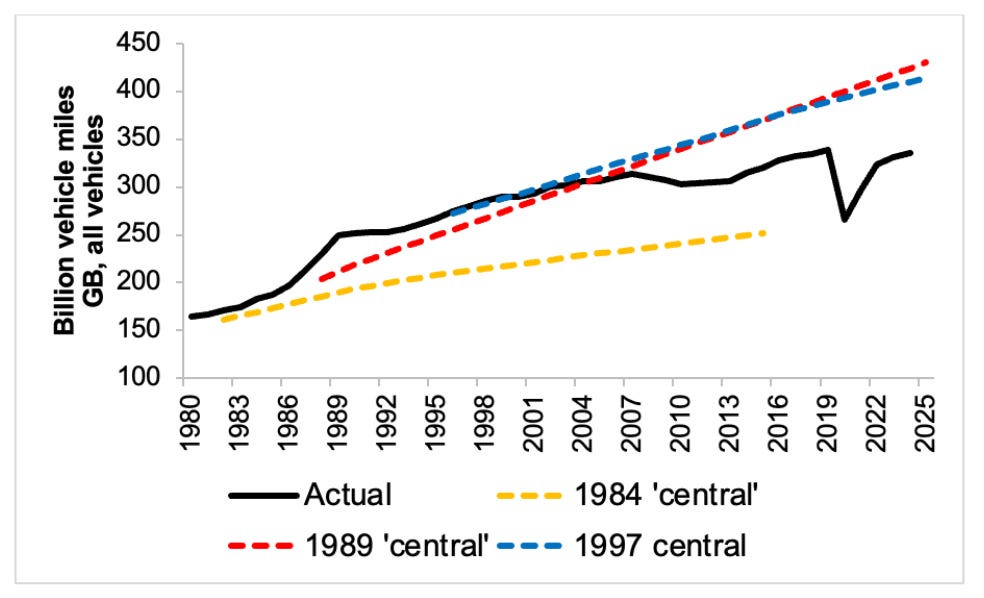
The trouble, as Goodwin sets out, is that this entire period was one in which national traffic growth was being persistently overestimated. The official National Road Traffic Forecasts from 1989 onwards were revised downwards again and again as reality failed to keep pace with them. If the national forecast is too high, the local forecast that sits underneath it tends to be too high as well. So when a scheme carried less traffic than predicted, the most likely explanation was not that induced traffic was absent. It was that the underlying growth forecast had been too optimistic in the first place. Comparing the out-turn to a forecast that was already wrong tells you almost nothing about induced traffic. All it says is that the original forecast was wrong.
The proper counterfactual is not the old forecast at all. It is the observed trend on comparable roads that were not improved, in the same region, over the same period. You measure how traffic grew on the untreated roads, apply that growth rate to the treated road to estimate what it would have carried without the scheme, and the gap between that estimate and the actual flow is your induced traffic. This is not a new idea. It is essentially the method that the Campaign to Protect Rural England and the Countryside Agency had been pressing for years. I should be honest that I have not read those two reports in full myself, and I am relying on Goodwin’s account of them, but the methodological point is clear enough and it is not seriously contested.
What is genuinely encouraging is what happened next. National Highways did not engage with the criticism for a long time. Then, quietly, after 2019 it stopped publishing the meta-analyses that claimed most schemes showed no induced traffic, and in 2024 it issued a revised evaluation manual that, in effect, adopted the very method its critics had been advocating, and criticised its own earlier approach. This is the POPE Methodology Manual 2024, and it is the same document referenced in the footnotes of the A5-M1 evaluation I have been quoting.
In other words, the report that prompted this whole piece is itself a product of the better method. When the A5-M1 evaluation talks about comparing observed journey times against an estimate of how they would have deteriorated without the scheme, that is the counterfactual at work. When it attributes growth on the M1 above national and regional trends to the project, that is the counterfactual at work. I can be confident that the changes I have seen on the ground are down to the scheme itself and not wider factors.
The reason induced traffic and induced demand have been so poorly understood is not that the underlying ideas are obscure or exotic. It is that the evaluation of schemes has, for a long time, been of poor quality on precisely the question that has been at the heart of transport planning for more than fifty years. We measured forecasting error and called it induced traffic, and the two are not the same thing.
This is why I get uneasy when the A5-M1 result is read as just another case of forecasts overstating benefits. The appraisal assumed larger changes in traffic than were observed, and the model’s assumptions about economic development and traffic patterns were a likely factor. The forecasts for the M1 between junctions 9 and 11a were reasonably accurate, but for most of the local roads and the A5 north of the bypass they fell outside the accepted plus or minus fifteen per cent range, with the difference on the A5 north of the bypass at around thirty-four per cent. That is a story about forecasting accuracy and model assumptions. It is not, on its own, a measurement of induced traffic, and the evaluation is careful not to pretend otherwise. It also flags real data quality problems, with some count sites differing from expectations by more than half, and one site excluded altogether. These caveats are not throat-clearing. They are the difference between an honest evaluation and a misleading one.
The good news is that the tools to do this properly now exist. National Highways’ 2024 manual is the obvious one, and Goodwin treats the recent re-evaluation of the M1 all-lane-running junctions, published in February 2026, as a proof of concept that the new method can deliver sensible conclusions even if it has not yet been used to recompute the appraisal effects of induced traffic in full.
Beyond the strategic road network, Active Travel England has been building out its own monitoring and evaluation guidance and its scheme review tools, and commissioned an evidence review in May 2025 looking at how appraisal guidance should be updated to capture the benefits that current methods miss. That last point matters more than it might first appear. The same logic that produces extra traffic when you add road capacity produces reductions when you reallocate it to public transport or active travel. The effects are as important for the objectives of Active Travel England and local planning departments as they are for the highways authorities.
If the counterfactual is the first technical issue, the treatment of freight is the second, and it is more uncomfortable because it is a known error that we have chosen to live with.
Here is the position as Goodwin describes it. The DfT’s guidance on variable demand modelling, TAG Unit M2.1, devotes a single sentence to freight. It says, in effect, that any response in the demand for freight transport is not considered, and that total freight traffic is generally assumed to be fixed, though it can be re-routed. National Highways has gone further than this, stating in evidence that light and heavy goods vehicles do not experience variable demand at all because their journeys are driven by commercial needs, and so they remain constant between the do-minimum and do-something scenarios.
In the words of Captain Blackadder, there is one small flaw in this plan: it is b******s.
Goodwin’s judgement is blunt and reflects my own thoughts on this for years. The assumption of fixed freight demand is simply wrong. Goods traffic plainly responds to changes in the time and money cost of travel, whether brought about by new capacity, by traffic management, or by pricing. The big operators run sophisticated optimisation of their own fleets and schedules. The small operators survive on their awareness of road conditions and their willingness to fit in one more delivery if the journey gets quicker. The industrial case made for schemes like the Lower Thames Crossing, that they will let firms reach new markets, is itself an admission that freight traffic is induced. To assume otherwise is, as Goodwin puts it, to build a major and systematic bias into economically crucial activity, and to call it a fixed quantity.
This bears directly on the A5-M1 evaluation. The bypass was meant to remove strategic traffic, and heavy goods vehicles in particular, off Watling Street through Dunstable, and the local authority backed this with weight restrictions on the local network. The evaluation found that flows for heavy goods vehicles on the new bypass were two to three per cent higher than predicted2. It then could not say what that meant for emissions, because there was not enough speed data, and the greenhouse gas benefit could not be re-forecast at all. Think about that. A scheme whose central purpose involved redistributing freight, evaluated using a framework that assumes freight demand does not vary, with the freight-relevant outcomes left unquantified due to want of data.
The important thing about the freight problem is that it is not a problem you can fix by flicking a switch. Goodwin is clear that freight cannot simply be bolted onto the classic four-stage model built for personal travel. A delivery round visiting a hundred different addresses, different every day, with pricing structures and competitive pressures all of its own, and with the blurring of the line between goods delivery and the household shopping trip it replaces, is a different beast that needs a different kind of model. That is a major exercise, likely to take years, and he argues it should be programmed as a matter of urgency rather than parked until the current freight modelling work is finished. In the meantime, he proposes pragmatic interim fixes, such as mirroring the induced-traffic adjustment already calculated for cars onto freight, given that the empirical elasticities appear to be broadly similar. The honest summary is that this is a known fault with a partial short-term workaround and a long, properly resourced research programme as the only real cure3.
My third central point is the one I most want readers to take away, and the A5-M1 is the perfect illustration of it. Even if we measured induced traffic perfectly, it is just one aspect of how success is judged. You have to look at the whole picture.
Consider what the bypass actually achieved in Dunstable. The town centre had a declared Air Quality Management Area (AQMA), with two locations where pollution exceeded the standards. The scheme was designed to route strategic through-traffic, and the heavy goods vehicles in particular, around the town rather than through it. The five-year evaluation, drawing on Central Bedfordshire Council’s own 2023 air quality monitoring, found widespread compliance with the nitrogen dioxide objective across Dunstable, including within the Management Area. As a result, in 2024, the AQMA was fully revoked.
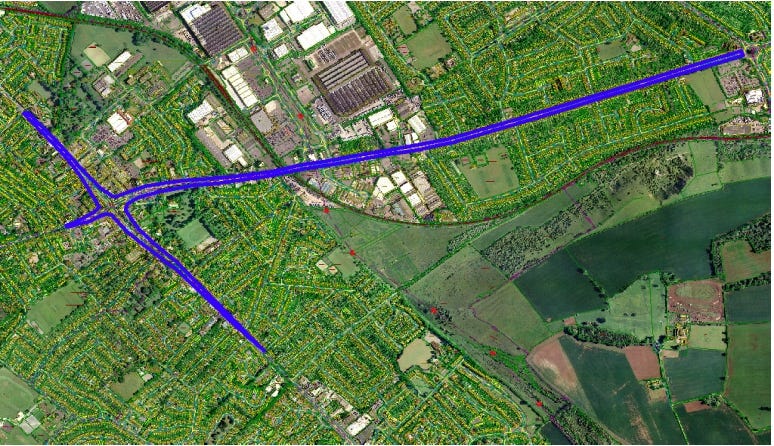
It is not the only benefit either. Personal injury collisions in the project area roughly halved, from an average of thirty-two before construction to sixteen after, with reductions in both serious and slight collisions. Journeys became faster and more reliable than both the before period and the counterfactual, and the evaluation estimated nearly six hundred thousand vehicle hours saved in the fifth year alone. The bypass took an average of around thirty-six thousand vehicles a day out of the centre of Dunstable, with local roads such as Thorn Road and Luton Road seeing large falls in traffic against a regional backdrop of rising traffic. The scheme came in under budget, at £148 million against a forecast of £160 million. While it’s re-forecast value for money came out as lower than what was anticipated, this was a fall from ‘very high’ to ‘high’ value for money. This shortfall was driven mainly by lower journey-time savings because traffic grew more slowly than the appraisal assumed.
This does not mean that building a road was the right solution, or that it is always the right solution. It is that, ultimately, the right verdict on the A5-M1 is a multi-criteria one, weighing cleaner air in Dunstable, safer and more reliable journeys, and real local decongestion against slower-than-forecast growth, an uncomfortable wider safety signal, gaps in the emissions evidence, and yes, increases in traffic levels. Reduce it to a single number for induced traffic and you would learn almost nothing useful about whether it was a good scheme. Goodwin makes the same argument from the theory side. There are circumstances, he notes, where induced demand brings additional economic, health and environmental benefits without imposing extra costs, and the question of whether benefits exceed costs can almost never be settled by looking at highway capacity and traffic in isolation.
So where does this leave us, and what should we actually do? I want to end on the conclusions I have come to, as they pull in a direction that I think the current mood in transport planning is in danger of missing.
The first thing that worries me is over-correction. Having spent this whole piece arguing that our models have been used badly, I am not about to argue that we should stop using them. Yet there is a growing undercurrent in vision-led planning where modelling is quietly ignored, or treated as a tiresome second-order check to be brought out only once the vision has been agreed. I understand the impulse. But a vision without a model is just a wish. Modelling, done honestly and read with appropriate humility about its limits, is one of the few tools we have for thinking rigorously about the future and the consequences of our choices within it. The right response to a flawed instrument is to recalibrate it, not to throw it away and navigate by feel. If we disregard model results in favour of grand visions, we will simply have swapped one kind of motivated reasoning for another, and the second kind is harder to argue with because it is based on gut feel.
The second thing follows from the first. We should challenge our assumptions about induced traffic and induced demand across every scheme through rigorous assessment and evidence. The induced-demand idea is symmetrical. It applies to the new bypass, the bus lane, and the new segregated cycle track. If we are serious about it, we test it everywhere, with the same counterfactual rigour, and we follow the evidence even when it inconveniences us. Maybe this will help us to challenge some other more popular matters considered to be truths, such as railways always underestimate their demand.
Poor evidence is what got us into this mess. A lack of evidence will not get us out of it, and neither will a confident vision that declines to be tested. The only way out is the slow, honest, accumulation of better evidence, applied evenly to everything we build and everything we choose not to build, including evidence that may tell us an inconvenient truth.
While I love writing this, and my writing will always remain free to view, if you are able to donate whatever little you can to help out it is much appreciated. I do have bills to pay after all! You can do that right here.
👩🎓 Further Reading
The clever clogs at our universities, government departments, and other clever people have published the following excellent research. Where you are unable to access the research, email the author – they may give you a copy of the research paper for free.
Congestion in highways when tolls and railroads matter: evidence from European cities
TL:DR - Using data from the 545 largest European cities, the authors show that expanding lane kilometres increases vehicle traffic and does not solve urban congestion. It is a strong read because it is the leading European counterpart to the famous US studies, and crucially it finds induced demand is much smaller where road pricing applies and that congestion falls with expanded public transport
Do highway widenings reduce congestion?
TL:DR - This Dutch study looks at the effects of widenings on congestion and travel demand up to six years afterwards, and finds that although travel-time savings erode in the long run through induced demand, the welfare benefits during the transition are substantial.
Suburbanization and transportation in European cities
TL:DR - This study examines whether highway and railroad improvements cause population suburbanization across 579 European cities in 29 countries between 1961 and 2011. This is the long-run land-use side of induced demand, showing how infrastructure reshapes where people live and not just how much they drive, which adds depth to any discussion of demand that goes beyond short-term traffic counts.
TL:DR - This recent paper uses US state-level panel data from 2000 to 2019 and a Spatial Durbin Model, finding that increased vehicle miles travelled in one state spills over to increase travel in neighbouring states.
Who does new trips and why? An analysis toward the modeling of induced demand
TL:DR - This paper proposes a three-step framework to identify and model induced trips, using discrete choice models in which trip frequency depends on factors such as age, household type, car ownership and trip purpose
😀 Positive News
Not so much positive news on induced demand (have you tried searching for something like that? Good luck!), but some general commentary on the matter that might be of interest to you.
RIS3: the future of England’s roads
Former National Highways chief Graham Dalton reviews the third Road Investment Strategy, published on 26 March 2026 and covering 2026 to 2031, noting it focuses on maintenance and renewal, builds no new smart motorways, and lists the Lower Thames Crossing as effectively the only big capacity project.
Phil Goodwin sets out how for most of the last 35 years official forecasts have systematically over-predicted traffic growth, with successive forecasts revised downwards, and how the high predictions led to extra capacity that itself induced traffic, creating an element of self-fulfilling forecasts at local level.
Germany’s ‘most expensive motorway’ opens in Berlin
This reports the opening of the A100 extension in Berlin, a 3.2 kilometre section costing around 721 million euros, the most expensive stretch of new highway in Germany at roughly 225,000 euros per metre. It is a vivid European case study of the politics of urban road expansion
💻 Hard Work
Over the last week, I have run two Evidence Safaris to inform a transport strategy. They were excellent, but tiring!
🎶 Musical Finale
Trying to find a song about induced demand is really hard, you know that? Instead, how about a song that (tangentially) deals with traffic restraint? That is what Talking Heads’ (Nothing But) Flowers is. Ok, its more a screed against the modern world and the evils of capitalism, but when it talks about ripping out roads and returning to nature, its a good enough fit for me.
🪧 Notices
This section is intended to notify you of important things that may or may not annoy you, depending on your view of the world. But these are things I feel it is worthwhile pointing out.
Regarding Artificial Intelligence. For my newsletter, I use AI like a research assistant. I get the AI (in my case Claude Opus 4.8) to find for me well-cited and evidenced research in the subject matter, focussed on academic journals with a high impact factor. I follow this up with my own research, and I check each source myself. Where I have the time to, I contact domain experts or seek out their published works to validate the findings. The words written here are my own, spelling mistakes and all.
Regarding my expertise. I am a transport planner, so my realm is public policy, how people and things move, and their impacts. While I research everything in a manner I consider robust, there may be some instances where my lack of domain expertise fails me. That’s on me, but that’s all part of learning. I always encourage any reader to do their own research on the subject matter.
✅ Sign Up
If you have been sent this newsletter, please consider signing up. Its free, and I don’t spam your inbox with random rubbish - just my own words.
This road itself no longer exists. Well, technically it does, but it has been subsumed into a much bigger housing development in this part of Houghton Regis. Seeing traditional small farm buildings surrounded by your bog standard new build is somewhat jarring.
It should be noted that one month before the opening of the A5 to M1 Link, the Woodside Link connecting employment areas in Dunstable and Houghton Regis to the new M1 Junction 11a was also completed, which is likely to have had an effect on this.
I would add that freight is not the only piece of unfinished modelling business Goodwin identifies, and the others are also research questions rather than quick fixes. There is the long-running worry about speed-flow relationships and so-called hypercongestion, where some models may assume a road can carry more traffic than is physically realistic, which he thinks warrants a small dedicated study. There is the awkward fact that our models assume responses are instantaneous and permanent, when the evidence suggests induced traffic builds over years and may roughly double between the first and fifth year after opening. And there is the case, made by earlier consultant reviews and supported by Goodwin, for new econometric modelling that can separate the traffic due to external trends from the traffic due to the scheme itself, and put an explicit timescale on the response. None of these are reasons to distrust modelling. They are a to-do list for making it better.